Cleanroom Classifications: Everything You Need to Know
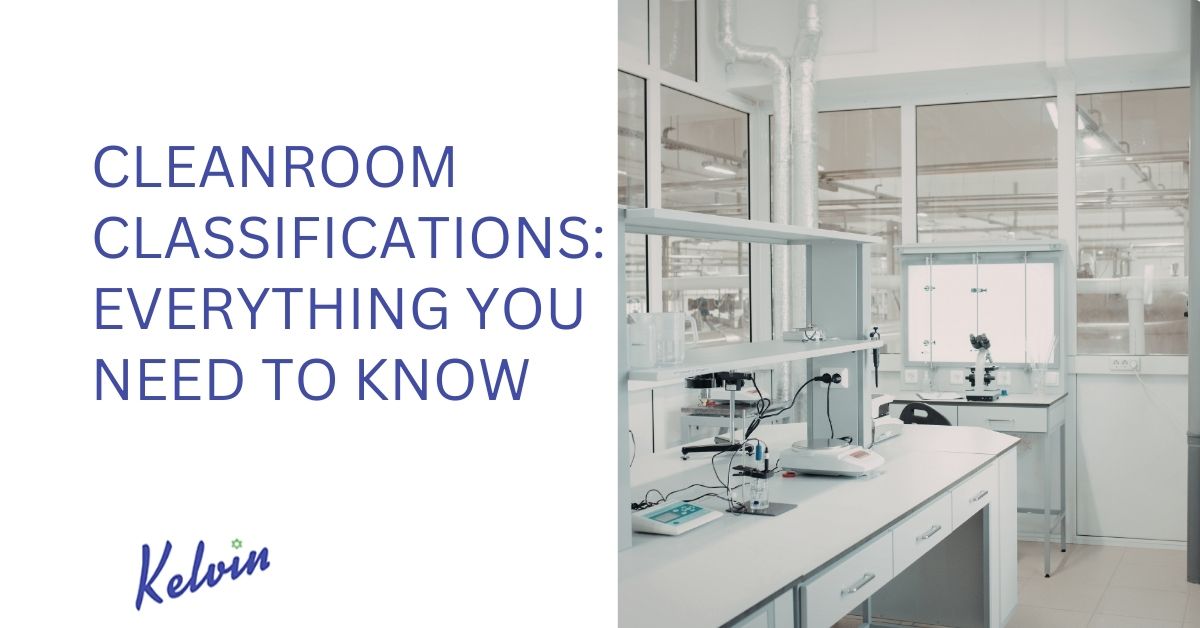
In industries where precision, safety, and quality are non-negotiable, maintaining a controlled environment is critical. This is where cleanroom classification becomes essential. Cleanrooms are specially designed spaces that control airborne particles, temperature, humidity, and pressure to minimize contamination.
Cleanroom classifications are defined by international standards that specify the maximum allowable concentration of airborne particles in a given space. These classifications help organizations determine how clean an environment needs to be for specific operations.
On that note, Kelvin Air Conditioning and Ventilation Systems – a leading team of MEP contractors in India and annual HVAC maintenance contractors – decided to share an extensive guide on cleanroom classifications. Read on!
What is Cleanroom Classification?
Cleanroom classification refers to the system used to categorize cleanrooms based on the maximum allowable concentration of airborne particles. These standards are defined under ISO 14644-1, which classifies cleanrooms from ISO Class 1 (cleanest) to ISO Class 9 (least clean).
The purpose of cleanroom classification is to control airborne particles such as dust, microbes, and chemical vapors to ensure precision, safety, and regulatory compliance. Choosing the right classification depends on the industry, process sensitivity, and contamination risk.
ISO 5 Cleanroom
An ISO 5 cleanroom is designed for highly sensitive and sterile operations. It allows a maximum of 3,520 particles (≥0.5 microns) per cubic meter of air. This classification is commonly used in sterile pharmaceutical manufacturing, aseptic filling, injectable drug production, and advanced medical device assembly.
ISO 5 cleanrooms typically use HEPA or ULPA filters with laminar airflow systems to maintain ultra-low particle levels. Strict protocols, continuous monitoring, and precise airflow control are essential to maintain ISO 5 standards.
ISO 7 Cleanroom
An ISO 7 cleanroom allows up to 352,000 particles (≥0.5 microns) per cubic meter of air. It is widely used in pharmaceutical packaging, electronics manufacturing, medical device production, and laboratory environments.
Compared to ISO 5, an ISO 7 cleanroom is more flexible and cost-effective while still offering strong contamination control. It usually incorporates HEPA filtration and controlled airflow but with less stringent operational requirements.
Other ISO Cleanroom Classifications
In addition to ISO 5 cleanroom and ISO 7 cleanroom, several other ISO classes are commonly used across industries:
ISO 1 Cleanroom
The cleanest environment available, mainly used for nanotechnology and advanced research. Extremely rare due to high operational costs.
ISO 2 Cleanroom
Used in semiconductor and microelectronics manufacturing where ultra-fine contamination control is required.
ISO 3 Cleanroom
Suitable for precision electronics, optics, and aerospace component production.
Recommended: Browse Wired and Wireless, our green energy venture
ISO 6 Cleanroom
Commonly used as a buffer or support area for ISO 5 environments in pharmaceutical and medical facilities.
ISO 8 Cleanroom
Widely used in pharmaceutical manufacturing, food processing, and automotive industries where moderate cleanliness is acceptable.
ISO 9 Cleanroom
Comparable to normal indoor air, often used for general manufacturing or non-critical processes.
Recommended blogs:
HVAC fire dampers: Everything covered
Why heat pumps make loud humming sound
Why do HVACs leak water?
Perfect workplace humidity levels
HVAC installation tips and ideas
Key Differences Between ISO Cleanroom Classes
The main difference between ISO cleanroom classes lies in the allowable particle count and airflow control. Lower ISO numbers indicate higher cleanliness levels. For example, an ISO 5 cleanroom requires far stricter contamination control compared to an ISO 7 cleanroom or ISO 8 cleanroom.
Operational costs, maintenance requirements, and growing protocols also increase as the ISO class becomes more stringent.
Why Cleanroom Classification is Important?
Proper cleanroom classification ensures compliance with regulatory bodies such as ISO, GMP, and FDA. It helps prevent contamination, improves product quality, and reduces the risk of costly production failures.
By selecting the appropriate ISO class, businesses can balance compliance, performance, and operational efficiency.
Consult Kelvin for Cleanroom Expertise
Understanding cleanroom classification is critical for industries that depend on controlled environments. Whether it’s an ISO 5 cleanroom, ISO 7 cleanroom, or other ISO classes, each classification serves a specific purpose.
Call us today at 81085 55060 or 70455 09909 to build a standardized cleanroom or consult one of our engineers about additional industry-wise cleanroom requirements. We are trusted for these services across India: