Commercial MEP Design Mistakes That Cost Businesses Lakhs (And How to Avoid Them)
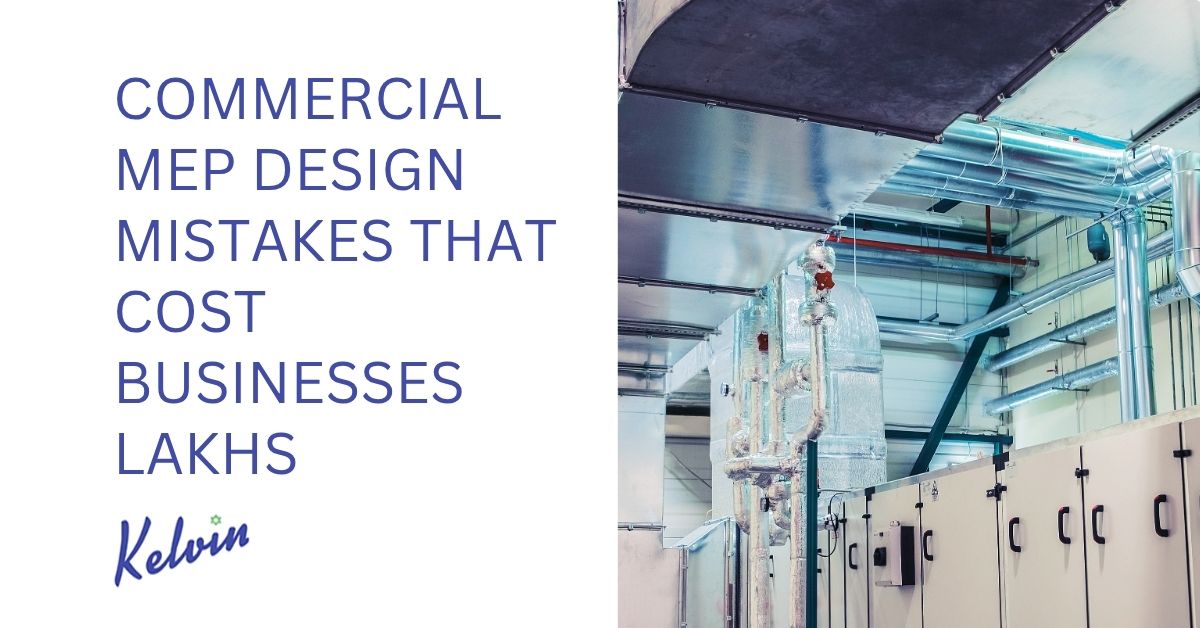
MEP systems are silent backbone of commercial buildings in India. They quietly provide comfort, safety, and efficacy. But hey, can you afford to make mistakes in designing commercial MEP? Definitely not. While mistakes can be stepping stones to growth for us humans, you can’t say the same for it.
Make even a tiny miscacluation and you end up snowballing expensive rework, energy inefficiencies, and compliance headaches. You will be paying lakhs of rupees even before you realise. We bet no business wants to sign up for that, right?
But the real question is how would you even know what mistakes slipped through? In this blog, Kelvin will share a list of the most common commercial MEP design mistakes. We will even tell you how to avoid them.
In a rush? Check out this quick version:
Commercial MEP Design FAQs
What are common commercial MEP design mistakes?
– Poor load calculations
– Lack of coordination between disciplines
– Ignoring energy efficiency standards
– Inadequate ventilation planning
– Improper equipment placement
– Overlooking future expansion needs
– Skipping detailed documentation
Why hire Kelvin as MEP contractor in India?
Combining deep technical expertise and precise planning, Kelvin has been delivering efficient, compliant, and built-to-last MEP systems for 10+ years now. We focus on cost control and future-ready design. Meaning, your business will be able to tackle expensive mistakes, all while getting long-term performance!
Now let’s discuss everything in detail!
What are Common Commercial MEP Design Mistakes?
Here are some common mistakes made while designing MEP for your commercial building. We have also shared their solutions so that you can safeguard your investment before minor oversights turn into major financial setbacks:
Poor load calculations
load calculations are heartbeat of any MEP systems. They silently determine whether your building breathes comfortably or gasps under pressure. Calculations made in haste or on a guesswork may cause your system to be oversized where they just wasting power like a leaking tap.
Or they can turn out to be undersized where they are not able to match building demands. In either case, you will get increased utility bills, poor cooling or heating and constant system failures that eat into your pocket.
How to prevent this
To prevent this, MEP engineers need to use accurate data. Factor in:
– Occupancy patterns
– Equipment loads
– Climate conditions
– Usage diversity
Think of this solution as tailoring a suit, not getting a readymade one off the rack. An accurate load calculation means your MEP system will work smoothly without undue strain. You will not face expensive surprises in the future.
Lack of coordination between disciplines
In commercial MEP design, mechanical, electrical and plumbing systems should move like a synchronised dance rather than three performances. When they work in isolation, clashes creep in. How, you ask? Via ducts cutting through beams, pipes blocking cable trays, and equipment competing for the same space.
Such conflicts usually emerge during MEP construction, causing delays, redesigns, and costly rework. It is anarchy in the name of supervision.
How to prevent this:
The more intelligent solution is to coordinate early using tools like BIM where all systems are mapped in a common digital space. This will enable teams to detect and rectify conflicts prior to reaching your building.
When coordination clicks, MEP design projects begin to run in a straight line. Schedules are easily maintained. And budgets remain where they need to be!
Ignoring energy efficiency standards
Skipping energy efficiency standards may seem like trimming fat from the budget. But it tends to become a slow financial hemorrhage. Weak MEP system designs waste more power. They inflate operational costs and can even be a subject of compliance or penalties.
Over time, you’ll begin feeling that what appears to be savings upfront is silently turning into a repeated expense that is not going to shrink at all. Modern buildings are expected to be energy-conscious. Not only for cost reasons but also for sustainability goals.
How to prevent this:
Talking about solutions for this MEP design issue, you need to:
– Incorporate efficient equipment, intelligent controls, and designs that reduce energy wastage from the initial stage.
– Adhere to codes and standards. It is a safeguard that will make sure your building works to its maximum capacity without endangering your long-term investment.
Inadequate ventilation planning
Ventilation is the unseen storyteller of building’s comfort. It shapes how people feel without ever being noticed. If planned poorly, it causes stale air, humidity issues, and discomfort that occupants may not quickly trace back to design faults. It even influences productivity, health and experience in commercial spaces.
Worse? Ventilation after putting MEP design into play often involves fixes and modifications that can straight up burn a big hole in your wallet.
How to prevent it:
You need to create an intelligent MEP design that focuses on occupancy density, activity rates, and indoor air quality. This way, you can make sure fresh air circulates to the places where it is needed the most. It is not simply a matter of moving air but of creating an environment where employees feel good and function at their best.
A well-designed MEP ventilation can turn a commercial building from merely functional to genuinely livable.
Don’t forget to check out these resources:
Improving HVAC air filtration
Cost to install geothermal HVAC
A guide on choosing HVAC system for your building
Maintaining perfect workplace humidity levels
Improper equipment placement
Installing MEP equipment without any vision is similar to putting your car keys in a locked drawer. Everything is fine until you really need access. Inadequate positioning may limit air flow, reduce system effectiveness, and complicate routine maintenance. Technicians will have trouble accessing units. Leading to skipped serving or higher labour expenses.
In the long run, such negligence reduces the life cycle of equipment and invites unforeseen failures.
How to avoid it:
You need to place everything smartly. This means taking clearances, accessibility, safety norms, and operational efficiency into account from day one. Make sure equipment has enough breathing room, is logically positioned, and has easy service access.
This way, maintenance becomes a smooth routine rather than an annoying puzzle. You can save both time and money.
Overlooking future expansion needs
Desinging commercial MEP system isn’t just a one-time thing. You need to think beyond the present requirements. Why, you ask? Because businesses change, teams grow, and technology demands shift. Systems that aren’t designed to scale can cost you a lot, literally.
Even minor extensions may result in large-scale redesigns, tearing into walls and ceilings. Rather than following this reactive strategy, switch to proactive one. Here’s what you need to do so that your building adapts without disruption:
– Incorporate spare capacity
– Create flexible layouts
– Provisions for additional loads
Think of it as giving your building extra space to grow with your business. A future-ready design ensures that you are not forced to incur the expense of updating every time a new technology is introduced. That your operations continue to run without hiccups.
Skipping detailed documentation
Yes, documentation doesn’t look glamorous at all. But it is the compass that keeps your MEP design project on its path. Incomplete or vague drawings, specifications and system details easily spread confusion across teams. Contractors may interpret things differently. Mistakes will creep in. Execution will drift away from design intent.
This usually results in rework, delays and unwarranted costs.
How to avoid:
To avoid this commercial MEP design mistake:
– Ask your MEP engineers to create fine, detailed documentation so that everyone understands the same language (from designers to installers).
– Record all connections, dimensions and specifications accurately.
Remember, it’s your blueprint to success. You can reduce risks and keep your project running like a well-oiled machine.
Hire Kelvin: Top MEP Contractors In India
Above are some mistakes that commercial building owners and their hired teams make while designing MEP systems. We hope now you understand that difference between a costly project and a cost-efficient one is basically a three-finger rule – expertise, planning, and precision from the start.
Kelvin has mastered all three. Serving in the MEP industry for 10+ years, we have a team of experienced professionals, advanced design practices, and commitment to detail. Hiring us means your MEP system won’t be just functional but also future-ready. We will calculate every single detail to minimise risks and maximise performance.
Contact us today at +91 8108555060 or +91 7045509909. Let’s turn your building into a space that runs smart, saves big, and stands strong for years to come!
We are also trusted for these services:
Annual HVAC maintenance in India