Predictive Maintenance for Chillers and AHUs: Can Data-Driven AMC Replace Calendar Servicing?
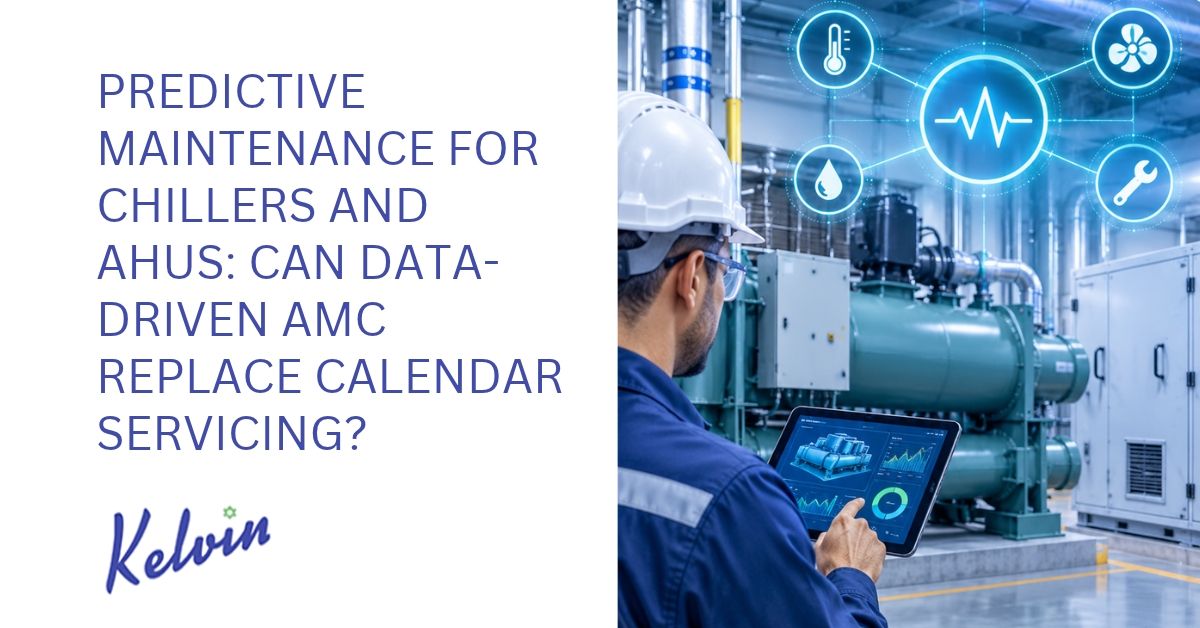
Chiller trips at 2 pm. Nobody saw it coming. The calendar said service was due next month.
That’s the gap in traditional servicing. A calendar doesn’t know your chiller’s condition. Predictive maintenance does. It uses live data like vibration, temperature, pressure and current to flag trouble weeks before it becomes a breakdown.
It’s November 2026. Across much of south, west and east India, chillers and AHUs are still carrying real load. Warm days. Humid nights. Equipment that has run hard since March.
So can data-driven AMC replace calendar servicing? Mostly, no. But it can make servicing far smarter. Here, Kelvin Mech – popular for HVAC annual maintenance – has explained how it works, what it costs and when it pays off.
What Is Predictive Maintenance, and How Is It Different From Preventive?
Three approaches cover most facilities:
| Approach | What triggers the work | Weak spot |
| Reactive | A breakdown | Surprise failures and downtime |
| Preventive (calendar) | The date or run hours | Servicing healthy equipment, missing early faults between visits |
| Predictive | The actual condition of the equipment | Needs sensors, data and someone to act on it |
Calendar servicing is better than waiting for failure. But it treats every chiller the same, whether it’s healthy or quietly deteriorating. Predictive maintenance looks at the equipment itself and says: this one needs attention now, that one can wait.
Which Predictive Maintenance Technologies Work for Chillers and AHUs?
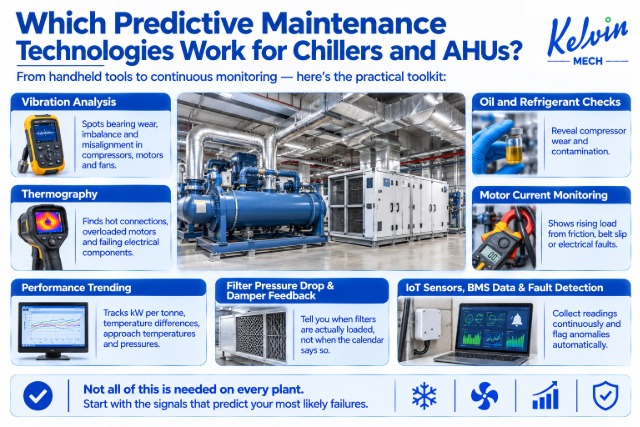
Predictive maintenance technologies range from simple handheld tools to continuous online monitoring. The US Department of Energy’s O&M guide highlights thermography, vibration analysis and performance trending, as summarised by Fluke. For HVAC, the practical toolkit looks like this:
- Vibration analysis: Spots bearing wear, imbalance and misalignment in compressors, motors and fans before they fail
- Thermography: Finds hot connections, overloaded motors and failing electrical components
- Performance trending: Tracks kW per tonne, temperature differences, approach temperatures and pressures against a baseline. A slow drift tells you a coil is fouling or a charge is dropping
- Oil and refrigerant checks: Reveal compressor wear and contamination
- Motor current monitoring: Shows rising load from friction, belt slip or electrical faults
- Filter pressure drop and damper feedback on AHUs: Tell you when filters are actually loaded, not when the calendar says so
- IoT sensors, BMS data and fault detection software: Collect readings continuously and flag anomalies automatically
Not all of this is needed on every plant. Start with the signals that predict your most likely failures.
What Savings Can You Realistically Expect?
Let’s keep expectations honest. The DOE’s guide estimates that a well-run predictive programme can cut maintenance costs 8 to 12% compared with preventive maintenance alone, and more where a facility is heavily reactive today. Industry studies cited in the same guidance suggest big drops in breakdowns and downtime too.
But that guidance is US-based and over a decade old, and results depend on equipment, data quality and how fast teams respond to alerts. Treat the numbers as direction, not a guarantee. The real win is usually avoided downtime, not cheaper visits.
Can Data-Driven AMC Replace Calendar Servicing?
Not completely. Some jobs are time-based no matter what the data says:
- Coil cleaning and chemical washes
- Filter replacement (though timing can follow pressure drop)
- Lubrication, belt checks and tightening
- Safety devices, controls and electrical inspections
- Statutory and warranty-linked checks
The smarter model is a hybrid. Keep a calendar baseline for the essentials, then add condition-based triggers on top. In dusty and humid Indian conditions, coils and filters foul quickly, so letting data decide when to clean often beats a fixed schedule. Visits become fewer but more targeted.
If you’re still weighing contract models, our guides to HVAC AMC costs in India and AMC vs on-call repairs show why reactive repairs usually end up costing more.
Which Equipment Is Worth Monitoring?
Don’t put sensors on everything. Rank equipment by what failure costs you:
- Chillers and large AHUs: Almost always worth it
- Critical areas: Data centres, hospitals, labs and cleanrooms, where downtime is expensive. Our data center HVAC guide explains the stakes
- Large commercial buildings: Malls and big offices with long operating hours, as in our shopping mall HVAC guide
- Small split units: Rarely worth the sensor cost. Good scheduled servicing is usually enough
What Does It Cost, and When Does It Pay Off?
Costs usually include sensors, a gateway, software subscriptions, integration with your BMS and the time of someone who reviews alerts. The payoff comes from avoided failures.
A simple test: estimate what one hour of cooling loss costs you, multiplied by the downtime a typical failure causes. If that number is large, monitoring pays quickly. If a short outage costs little, calendar servicing with good records may be enough. For illustration only, if one chiller failure costs ₹10 lakh in lost business and repairs, preventing even one a year can justify a lot of monitoring.
What Should You Ask a Vendor Offering Predictive AMC?
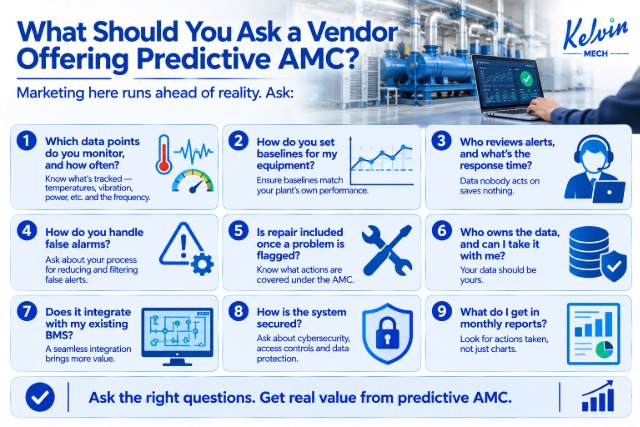
Marketing here runs ahead of reality. Ask:
- Which data points do you monitor, and how often?
- How do you set baselines for my equipment?
- Who reviews alerts, and what’s the response time? Data nobody acts on saves nothing
- How do you handle false alarms?
- Is repair included once a problem is flagged?
- Who owns the data, and can I take it with me?
- Does it integrate with my existing BMS?
- How is the system secured?
- What do I get in monthly reports? Look for actions taken, not just charts
Where Does Kelvin Mech Fit In?
Predictive tools only work on top of solid basics. Kelvin’s HVAC maintenance service and annual maintenance contract teams can help you decide which assets justify condition monitoring and which are fine on a good calendar. For sensors, controls and electrical integration, our MEP services and HVAC company in Mumbai teams can help plan the system.
Frequently Asked Predictive Maintenance Questions
What is predictive maintenance in HVAC?
It’s maintenance triggered by the actual condition of equipment, measured through data like vibration, temperature, pressure and current, instead of a fixed calendar.
Is predictive maintenance better than preventive maintenance?
It can be, for critical equipment. But it works best alongside preventive tasks like cleaning and lubrication, not instead of them.
Does predictive maintenance need AI?
Not always. Simple trending and alarms catch many problems. AI and machine learning help on larger plants with lots of data, but the basics come first.
Is it worth it for small buildings?
Usually not for small split units. Chillers, large AHUs and critical spaces are where it pays off.
Predictive Maintenance: Where This Leaves You
Predictive maintenance isn’t a replacement for good servicing. It’s an upgrade to it. The calendar still handles the essentials, while data tells you where to look harder, and when.
Start small. Pick your most critical chillers and AHUs. Set baselines. Make sure someone owns the alerts and acts on them. Add sensors only where failure would hurt. With equipment still working hard through a long warm season, a few smart signals can save you from the next 2 pm surprise.
Want to know which of your assets deserve monitoring? Talk to Kelvin’s team for a practical, no-hype assessment.