Basement and Car Park Ventilation and Smoke Extraction: System Design and Maintenance Checks
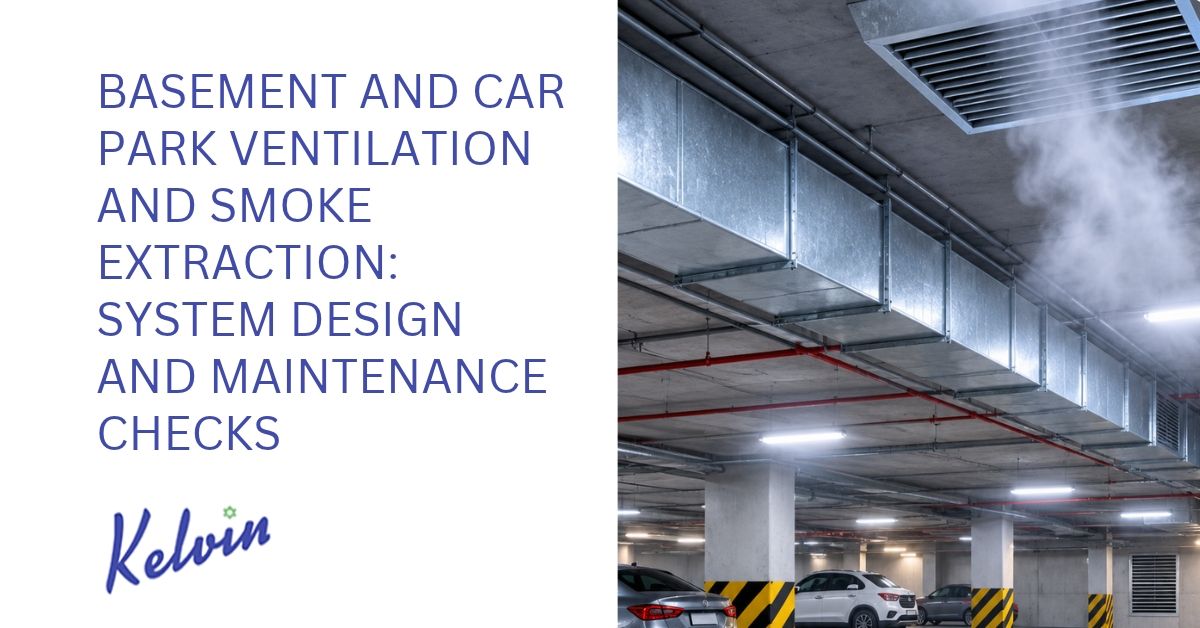
Basement. Engines idling. Ramp traffic. Exhaust fumes with nowhere to go.
Now imagine a fire. A car catches, smoke fills the level and everyone heads for the same few exits.
That’s why basement car park ventilation does two jobs in one. Every day, it clears carbon monoxide and fumes. In an emergency, it pulls out smoke and heat so people can leave and firefighters can enter. Most buildings install it once and forget it, until an inspector or a real fire tests it.
This guide from Kelvin Mech – best provider of ventilation design and contracting services in Andheri – explains how car park ventilation and smoke extraction systems are designed, what Indian codes say and the maintenance checks that keep fans, dampers and sensors ready when it matters.
Why Does a Basement Car Park Need Ventilation and Smoke Extraction?
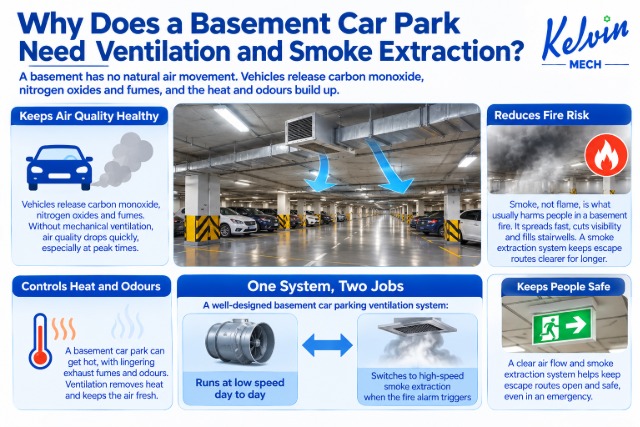
A basement has no natural air movement. Vehicles release carbon monoxide, nitrogen oxides and fumes, and the heat and odours build up. Without mechanical ventilation, air quality drops quickly, especially at peak entry and exit times.
Fire is the bigger risk. Smoke, not flame, is what usually harms people in a basement fire. It spreads fast, cuts visibility and fills stairwells that people need for escape. A smoke extraction system keeps escape routes clearer for longer.
Good news: one system can do both jobs. A well-designed basement car parking ventilation system runs at low speed day to day and switches to high-speed smoke extraction when the fire alarm triggers.
What Do the Codes Say in India?
Here’s an update many people have missed. In 2026, the Bureau of Indian Standards replaced NBC 2016 with the National Building Construction Standards (NBCS) 2026. Fire and life safety, earlier Part 4, now sits in Part F. The official Part F document says it is voluntary guidance, and that fire safety is enforced through state building bye-laws and fire authorities. So your state’s rules and your fire NOC conditions decide what’s mandatory.
Part F has a dedicated annex on car parking facilities. It also says smoke-management systems built into HVAC need documented testing and regular maintenance, and that emergency power should cover smoke venting equipment, including dampers and actuators.
As for air changes, the figures most often quoted under NBC 2016 were 6 air changes per hour (ACH) in normal mode and 12 ACH in smoke mode. Some authorities and consultants design to higher numbers. Always confirm the figure with your fire consultant and local authority before finalising a design.
How Is a Basement Car Parking Ventilation System Designed?
Normal mode
The system extracts vehicle fumes and brings in fresh air. CO sensors can ramp fan speed up when levels rise, so the system uses less energy when the car park is quiet. VFDs or two-speed fans make this possible.
Smoke extraction mode
When the fire alarm trips, the system switches to high-speed extraction automatically. Fans must be rated for high temperatures, often specified around 250°C for a set period, so they keep running in hot smoke. Extract points are usually arranged at both high and low levels to catch smoke and heat.
Make-up air
This is the part most often overlooked. Extracting smoke only works if fresh air can come in to replace it. Without a clear air path, such as supply shafts or open ramps, fans struggle and doors become hard to open. Good designs plan make-up air from day one.
Ducted systems vs jet fans
Ducted systems move air through ductwork to extract points. Jet fans (or impulse fans) push air along the ceiling toward extract points and cut ductwork. Many basements use a mix. The choice depends on ceiling height, layout and fire strategy. Your fire consultant should validate it.
Power and controls
Smoke extraction fans and dampers must work during a power cut, so they need emergency power from a DG set. Controls tie into the fire alarm panel and, in many buildings, the fire command centre. Planning the power side early avoids headaches later, as we covered in our piece on electrical MEP services.
What Maintenance Checks Keep the System Reliable?
A system that has never been tested in fire mode is a system you can’t trust. Here’s a practical schedule. Frequencies are typical starting points, so adjust them to your OEM, fire consultant and local authority.
| Check | Typical frequency |
|---|---|
| Fans run test in normal mode (noise, vibration, belts, bearings) | Monthly |
| Motor current and rotation direction check | Quarterly |
| Fire mode changeover test from the fire alarm panel | Quarterly |
| Fire and smoke damper open/close test | At least every 6 to 12 months |
| CO sensor calibration | Every 6 to 12 months |
| DG changeover test with fans running | Monthly or per site policy |
| Ductwork and fan cleaning | Annually, or more in dusty sites |
| Full system test with documented report | Annually |
Beyond the table, look for these:
- Make-up air paths. Make sure ramps, shafts and louvres aren’t blocked
- Damper access. Part F expects dampers to be accessible for testing and ducts to have inspection panels
- Jet fan direction and mounting. Check bolts, direction and alignment
- Control panel status. Look for faults, bypass switches left on or disabled auto modes
- Signage and records. Keep a log of every test, with dates and results
What Goes Wrong Most Often?
Systems tend to fail in boring ways:
- Fans never tested in fire mode, so the first real test is a real fire
- Dampers seized or actuators stuck after years of dust
- CO sensors drifting out of calibration, so fans never ramp up
- Three-phase fans running backwards after repairs
- Make-up air blocked by storage, parked vehicles or closed shutters
- Control panels left in manual mode after a maintenance visit
- No record of tests, which becomes a problem at inspection time
Most of these cost very little to catch early. A quarterly fire-mode test finds half of them.
What Should You Ask Your MEP Contractor?
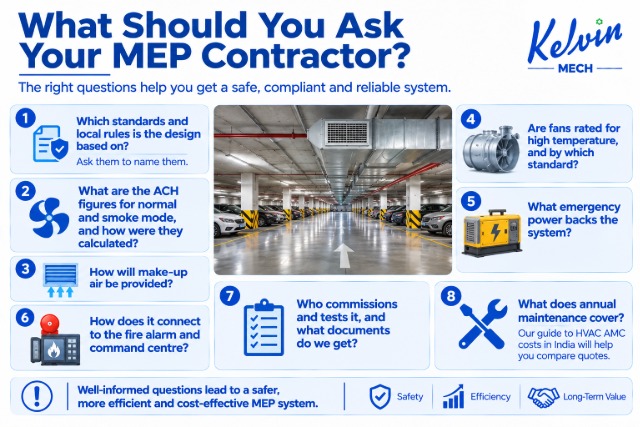
- Which standards and local rules is the design based on? Ask them to name them
- What are the ACH figures for normal and smoke mode, and how were they calculated?
- How will make-up air be provided?
- Are fans rated for high temperature, and by which standard?
- What emergency power backs the system?
- How does it connect to the fire alarm and command centre?
- Who commissions and tests it, and what documents do we get?
- What does annual maintenance cover? Our guide to HVAC AMC costs in India will help you compare quotes
Where Do Basements Matter Most?
Malls, hotels and large offices have the biggest basements and the heaviest traffic. Our guides to shopping mall HVAC and hotel HVAC systems cover how these buildings plan around crowds and peak loads. The car park is part of that picture, not an afterthought.
Where Does Kelvin Mech Fit In?
Basement ventilation and smoke extraction sit inside our MEP companies in India. Our HVAC company in Mumbai team designs and installs the systems, and our annual maintenance contract and value added services HVAC plans handle the testing schedule above, with records you can show an inspector.
Frequently Asked Questions
Is smoke extraction mandatory for basement car parks in India?
It depends on your state’s bye-laws and fire authority. NBCS 2026 Part F is guidance, and local rules decide enforcement. Most large basements are required to have it in practice.
How many air changes per hour does a basement car park need?
Figures commonly quoted under NBC 2016 were 6 ACH for normal ventilation and 12 ACH for smoke mode. Confirm current requirements with your local authority.
Can one system handle both ventilation and smoke extraction?
Yes. Many car parks use dual-purpose fans that run at low speed daily and switch to high speed in a fire.
How often should smoke extraction fans be tested?
Run tests monthly and fire-mode tests at least quarterly, then do a full documented test annually. Your OEM and fire consultant may set stricter intervals.
Car Park Ventilation: Where This Leaves You
A basement car park is easy to ignore. Nobody sees the fans, dampers or sensors until something goes wrong. That’s exactly why they deserve a plan.
Get the design right first: sensible air changes, a clear make-up air path, high-temperature fans and emergency power. Then keep it working with regular tests, calibrated sensors and proper records. The cost is small compared with the risk of finding out during a fire that the system doesn’t work.
Not sure how your basement system would perform? Talk to Kelvin’s team about an inspection and test plan.