Hot and Cold Spots? How HVAC Air Balancing Fix Them

Two desks apart. One person is in a jacket. The other is fanning herself with a file.
Same floor. Same AC. Different climate.
That’s unbalanced airflow, and in many Indian offices, hotels and hospitals it’s normal. The usual response? Drop the thermostat. Now the cold rooms freeze and the warm corner still sulks.
The real fix is HVAC air balancing. It measures how much air each outlet delivers, compares it with the design and adjusts until every zone gets its share. Add duct pressure testing and you catch leaks too. In this blog, Kelvin Mech – leading HVAC suppliers in India – how both work, when you need them and what to ask before you hire anyone.
What Causes Hot and Cold Spots in an HVAC System?
Rarely is it just “weak AC”. Most hot and cold spots come from how air moves, not how much cooling the plant makes. The usual suspects:
- Unbalanced airflow. Rooms near the fan get too much air while distant rooms get too little
- Leaky ducts. Cooled air escapes into ceiling voids before it reaches the room
- Dampers in the wrong position. Left closed, left open or never set after installation
- Layout changes. New partitions, added cabins or moved diffusers that nobody re-balanced for
- Blocked return air. Closed doors and no transfer grilles stop air from coming back
- Dirty filters and coils. They choke airflow across the whole system, as we explained in our guide to HVAC efficiency drop causes
Spot the pattern? Most of these are airflow problems. That’s why balancing works.

What Is HVAC Balancing, Exactly?
HVAC balancing is the process of measuring and adjusting airflow so each room gets the air it was designed for. In the industry it’s often called testing, adjusting and balancing, or TAB. One university specification defines it as checking and adjusting HVAC systems to meet design objectives, and recording and reporting measurements.
In practice, a technician will:
- Measure airflow at diffusers and grilles with a capture hood
- Measure duct airflow with a pitot tube or anemometer
- Check static pressure and fan performance
- Adjust dampers, fan speed or pulleys
- Record everything in a report
Chilled water systems have a water-side version too. Balancing valves make sure each AHU and fan coil unit gets the right water flow. If a room is warm even though the air is right, check the water.
Why Does Duct Pressure Testing Come First?
Balancing a leaky duct system is like tuning a leaking tyre. You can adjust it, but the leak undoes your work.
Duct pressure testing, also called duct leakage testing, seals off a section of ductwork, pressurises it with a test fan and measures how much air escapes. The result is compared with an allowed leakage limit. ENERGY STAR says that in a typical home, about 20 to 30 percent of the air moving through ducts is lost to leaks, holes and poor connections. That’s a residential figure, but commercial ducts built or modified hurriedly can leak badly too.
That’s why good specifications require leakage testing before balancing starts. The Duke University spec above asks contractors to confirm that duct leakage tests are complete, balancing devices are installed and clean filters are in place before TAB begins. Fix leaks first. Then balance.
How Does HVAC System Air Balancing Work, Step by Step?
Here’s a typical sequence:
- Pre-checks. Confirm filters are clean, fans rotate correctly, dampers are open and duct leakage tests are done
- Baseline readings. Measure existing airflow at every outlet and note complaints, so you can compare later
- Compare with design. Check measured values against the design airflow for each room
- Set total airflow. Adjust fan speed, through a VFD or pulleys, to deliver design airflow at the AHU
- Balance branches and terminals. Adjust dampers from the main duct to the branches and then to each outlet
- Final verification. Re-measure everything, because adjusting one damper shifts the others
- Report. Get before and after figures, instrument details and marked-up drawings
A decent job takes time, and rushing it usually means redoing it.
When Should You Rebalance Your System?
Don’t wait for tenants to complain. Plan for it:
- After installation. Every new system should be balanced before handover
- After layout changes. Fit-outs, partitions and new cabins all change airflow
- After major repairs. Fan, motor, duct or VAV box replacements
- When complaints persist. Especially the same rooms again and again
- Periodically. Every few years, or sooner in buildings that keep changing
Timing matters too. It’s November 2026, and in much of south, west and east India, offices and hotels are still running AC most of the day. Occupancy shifts, year-end fit-outs and festive crowds all change the load. A rebalance now fixes comfort problems before they carry into the next hot season. Hotels in particular live or die on room comfort, as we covered in our guide to hotel HVAC systems.
What Results Can You Realistically Expect?
Balancing isn’t magic, but it’s one of the cheapest fixes in HVAC. Expect:
- More even temperatures across rooms
- Fewer complaints and fewer thermostat wars
- Less overcooling, since people stop pushing setpoints down to compensate for hot corners
- Better use of the capacity you already paid for
- A clear record of how the system performs
Balancing can’t fix a system that’s undersized, badly designed or full of failed equipment. If readings show the plant can’t deliver, you’ll know that for certain, which is useful too. In big spaces like data halls and malls, balancing matters even more. See our guides on data center HVAC and shopping mall HVAC.
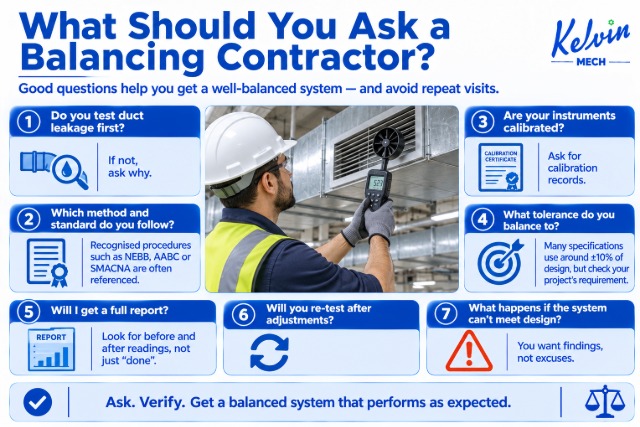
What Should You Ask a Balancing Contractor?
- Do you test duct leakage first? If not, ask why
- Which method and standard do you follow? Recognised procedures such as NEBB, AABC or SMACNA are often referenced
- Are your instruments calibrated? Ask for calibration records
- What tolerance do you balance to? Many specifications use around plus or minus 10% of design, but check your project’s requirement
- Will I get a full report? Look for before and after readings, not just “done”
- Will you re-test after adjustments?
- What happens if the system can’t meet design? You want findings, not excuses
Where Does Kelvin Mech Fit In?
Kelvin’s HVAC consultants team can look at why your building has hot and cold spots, from duct layout to load changes. Our MEP services cover the wider building systems, and our air handling unit maintenance and annual HVAC maintenance plans can keep filters, coils and dampers in shape so the balance holds.
Frequently Asked HVAC Balancing Questions
What is air balancing in HVAC?
It’s the process of measuring and adjusting airflow so each room gets its designed amount of air, using tools like capture hoods and pitot tubes.
How long does HVAC air balancing take?
It depends on the building size and number of outlets. A small office may take hours. A large building can take days.
Do I need duct pressure testing before balancing?
Ideally yes. Fixing leaks first means your balancing results hold up.
Can balancing reduce my electricity bill?
It can help, mainly by ending the habit of overcooling to fix hot spots. Results vary by building.
HVAC Air Balancing: Where This Leaves You
Hot and cold spots feel like a mystery, but they usually have simple causes: leaks, badly set dampers and airflow nobody ever measured. Balancing and duct pressure testing turn guesswork into numbers.
Fix leaks first. Measure what every outlet really delivers. Adjust, verify and keep the report. Then rebalance whenever your layout changes. It’s one of the most cost-effective improvements you can make, and it makes people more comfortable immediately.
Fighting hot and cold spots in your building? Talk to Kelvin’s team about a proper airflow assessment.