BEE’s New Star Rating Norms: How They’ll Change Your Next HVAC Purchase
If you’ve walked into an appliance showroom recently and noticed that a “5-star” AC looks suspiciously similar in price and spec to what used to be a 4-star model, you’re not imagining things. Starting January 1, 2026, the Bureau of Energy Efficiency (BEE) rolled out revised ISEER thresholds for room air conditioners, and the effect has rippled through every showroom, e-commerce listing, and procurement decision in the country. Whether you’re buying a split AC for your living room or specifying HVAC systems for a commercial site, the star on the label now means something different than it did last year.
At Kelvin Mech, we spend our days designing, installing, and maintaining HVAC systems across Mumbai and beyond, so we’ve been tracking this shift closely. Here’s what actually changed, why it matters, and how to buy smart under the new norms.
What Is the BEE Star Rating System, Anyway?
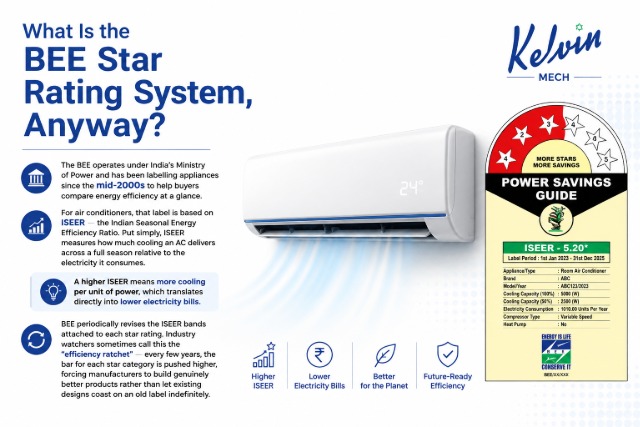
The BEE operates under India’s Ministry of Power and has been labelling appliances since the mid-2000s to help buyers compare energy efficiency at a glance. For air conditioners, that label is based on ISEER — the Indian Seasonal Energy Efficiency Ratio. Put simply, ISEER measures how much cooling an AC delivers across a full season relative to the electricity it consumes. A higher ISEER means more cooling per unit of power, which translates directly into lower electricity bills.
BEE periodically revises the ISEER bands attached to each star rating. Industry watchers sometimes call this the “efficiency ratchet” — every few years, the bar for each star category is pushed higher, forcing manufacturers to build genuinely better products rather than let existing designs coast on an old label indefinitely.
What’s Actually Changing This Year
The ISEER Threshold Shift
Under the revised 2026 norms, the ISEER requirement for a 5-star split AC has moved up to roughly 5.20 or higher, and the 3-star band now sits closer to an ISEER of 4.0–4.99. In practical terms, an AC that would have qualified for 5 stars under the 2025 rules now only clears 4 stars. A former 4-star model slides to 3 stars, and a former 3-star model drops to 2 stars.
Why Your “5-Star” AC Might Now Say “4-Star”
This is the part that trips up most buyers. The AC itself hasn’t gotten worse — its ISEER value and actual power draw haven’t changed one bit. What changed is the yardstick. BEE has simply reset what counts as excellent. So if you’re comparing a 2024-labelled 5-star unit against a fresh 2026-labelled 4-star unit, don’t assume the older one wins. Check the actual ISEER number and the label’s validity period, not just the star count.
You can cross-check any model against the official database, and BEE has also pushed its Check My Label verification tool as the standard way to confirm a listing is genuine — a step that’s become more important given rising instances of appliances sold with outdated or inflated labels on informal retail channels.
Why BEE Tightened the Norms
This isn’t a random policy tweak. Air conditioning already accounts for a fast-growing share of household and commercial electricity demand in India, and that curve is only steepening as summers get longer and hotter. By raising the efficiency bar, BEE is aiming to shave peak electricity demand, cut the pressure on the grid during heatwaves, and nudge the market toward genuinely low-consumption cooling technology rather than allowing manufacturers to keep selling the same hardware under an inflated label. For a deeper look at where cooling technology is headed in India, our piece on heat pumps versus traditional HVAC systems covers some of the same efficiency pressures playing out on the commercial side.
How This Affects Your Next AC Purchase
Price vs Long-Term Savings
Here’s the practical dilemma: a genuinely 5-star-rated AC under the new norms will cost more upfront than it did before the reclassification, because it now has to clear a meaningfully higher efficiency bar. If your AC runs for eight or more hours a day — which is common in bedrooms, offices, and server rooms — that higher price tends to pay for itself through lower electricity bills within a few years. If you’re only running the unit occasionally, a well-specified 3-star model under the 2026 norms may still perform close to what a 4-star model did in 2025, and it’ll be lighter on your wallet.
How to Read the New Label Correctly
Three things matter more than the star count alone:
- ISEER value — the actual efficiency number, not just the star band it falls into
- Label period / validity year — printed on the sticker, tells you which year’s standard the rating was tested against
- Annual power consumption (APC) — the estimated yearly electricity use in kWh, useful for comparing models within the same star band
Two ACs can carry the same star rating and still differ noticeably in real-world running cost, so it’s worth spending an extra minute reading past the stars.
Beyond Split ACs: What This Means for Commercial HVAC
Homeowners aren’t the only ones affected. Facility managers, developers, and businesses running larger HVAC installations — chillers, VRF systems, rooftop units — are watching the same efficiency-first direction from regulators, even where BEE labelling isn’t yet mandatory for every equipment category. It’s part of a broader compliance environment that also touches electrical MEP planning and temperature-sensitive facilities like the ones we cover in our guide to HVAC systems for cold chain and warehouse operations. If you’re planning a new build or a major retrofit this year, energy efficiency compliance is worth building into the project brief from day one rather than treating it as an afterthought.
For existing systems, the smarter play is often not to replace but to maintain well. A poorly serviced 5-star AC can perform worse than a well-maintained 3-star one. That’s a point we go into more detail on in our comparison of AMC contracts versus on-call repairs — regular servicing protects the efficiency you paid for.
A Quick Buying Checklist
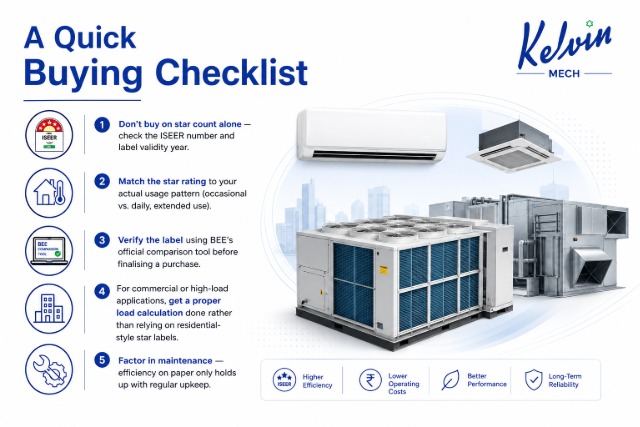
- Don’t buy on star count alone — check the ISEER number and label validity year.
- Match the star rating to your actual usage pattern (occasional vs. daily, extended use).
- Verify the label using BEE’s official comparison tool before finalising a purchase.
- For commercial or high-load applications, get a proper load calculation done rather than relying on residential-style star labels.
- Factor in maintenance — efficiency on paper only holds up with regular upkeep.
How Kelvin Mech Can Help
Whether you’re choosing a split AC for a single room or specifying a full HVAC system for a commercial facility, getting the sizing, installation, and maintenance right matters as much as the star rating on the box. Our team, one of the best HVAC suppliers in India, can help you select systems that genuinely meet the new efficiency standards, and our MEP contractors’ services division handles the broader electrical and mechanical planning that goes with it. Once installed, an AMC plan or scheduled HVAC maintenance service keeps your system running at the efficiency it was rated for — not just on day one, but for years afterward.
New BEE Star Rating For HVAC FAQs
Why does my new AC show a lower star rating than a similar model I bought last year?
The AC itself hasn’t gotten less efficient — BEE raised the ISEER thresholds required for each star band starting January 1, 2026. A model that would have earned 5 stars under the old norms may now only qualify for 4 stars, even though its actual power consumption is unchanged.
Is a new 3-star AC as good as an old 4-star AC?
Roughly, yes. Because the thresholds were tightened by about one full star band, a 2026 3-star AC typically performs close to what a 2025 4-star model did. Always check the ISEER value and label year rather than comparing star counts across different years directly.
How do I know if an AC’s star label is genuine and up to date?
Check the label’s validity period printed on the sticker, and cross-verify the brand and model number using BEE’s official Check My Label tool or comparison database. This is especially important for older stock still being sold at retail.
Should I always buy the highest star-rated AC available?
Not necessarily. A 5-star AC makes the most financial sense if you run it 8+ hours a day, since the higher upfront cost is offset by electricity savings over time. For occasional or low-usage rooms, a well-specified 3-star model under the 2026 norms may offer better value.
Do the 2026 BEE norms apply to commercial HVAC systems too, or only residential split ACs?
The revised ISEER thresholds specifically target room air conditioners, which covers most residential and light-commercial split units. Larger commercial systems like chillers and VRF setups aren’t governed by the same star-label scheme, but they’re increasingly subject to broader energy-efficiency compliance expectations, so it’s worth factoring efficiency into commercial HVAC planning regardless.
BEE New Star Rating Norms: Bottom Line
The new BEE norms haven’t made ACs worse — they’ve made the star label more honest. A 3-star HVAC now performs roughly where a 2025 4-star model did, and the market as a whole is more efficient than it was a year ago. The catch is that buyers need to look slightly past the stars — at the ISEER value, the label period, and their own actual usage pattern — to make a genuinely informed choice. Get that right, and your next AC purchase will cost less to run for years to come.