Heat Pumps vs Traditional HVAC in 2026: Is India Ready for the Shift?
India’s HVAC industry is entering a period of major transformation. Rising temperatures, rapid urbanisation, higher electricity consumption and growing demand for indoor comfort are pushing businesses and homeowners to look beyond conventional air-conditioning systems.
One technology gaining attention in 2026 is the heat pump. While heat pumps are widely used internationally for efficient heating and cooling, India’s HVAC market has traditionally been dominated by cooling-focused air conditioners, chillers and conventional heating systems.
On that note, Kelvin Air Conditioning and Ventilation Systems, a leading team of MEP contractors in India and annual HVAC maintenance contractors, decided to share this complete guide comparing heat pumps vs. traditional HVAC systems.
So, is India ready to make the shift from traditional HVAC to heat pump technology?
Understanding Heat Pumps vs Traditional HVAC
Traditional HVAC systems generally use separate technologies for heating and cooling. In many commercial and industrial applications, cooling is provided by air conditioners or chillers, while heating may rely on electric heaters, boilers or other fuel-based systems.
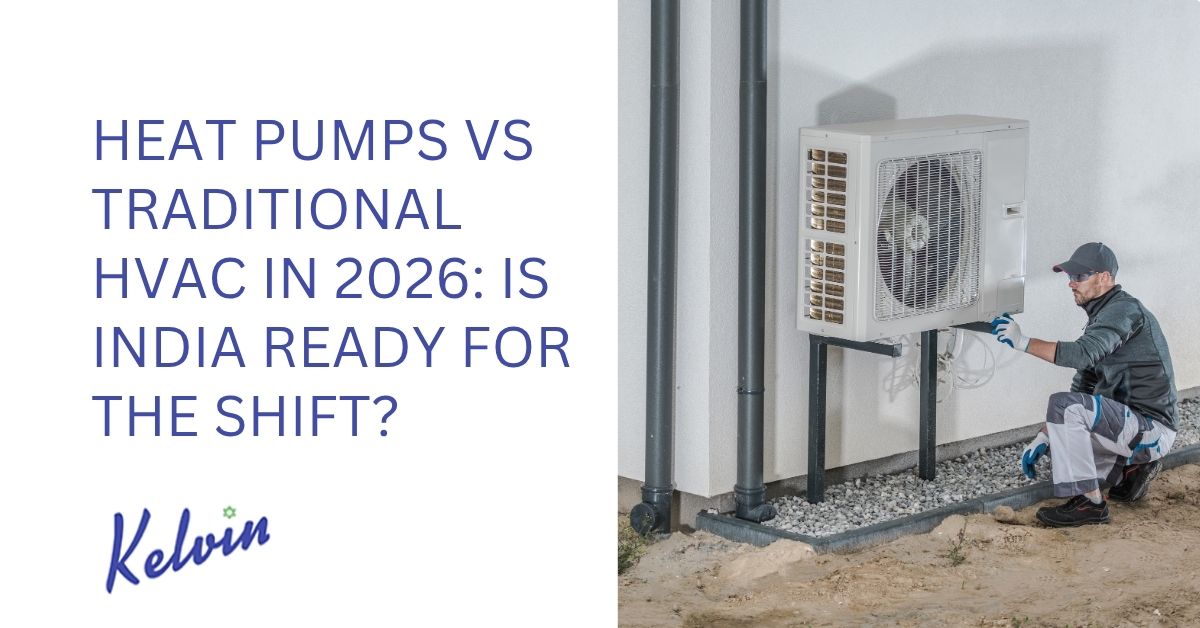
A heat pump works differently. It transfers heat rather than generating it directly. A reversible heat pump can provide cooling during hot weather and heating during colder months by reversing the direction of heat transfer.
This makes heat pumps particularly attractive for buildings that require both heating and cooling, as well as applications such as domestic hot water.
However, the Indian market presents a unique situation: cooling is a much larger requirement than space heating across most of the country. This means the business case for heat pumps needs to be evaluated according to location, building type and application rather than assuming one technology will replace all conventional HVAC systems.
India’s Growing Cooling Challenge
India’s demand for cooling is increasing rapidly. According to the International Energy Agency (IEA), cooling accounted for around 15% of India’s electricity demand growth between 2021 and 2025 and approximately one-third of electricity demand growth in the buildings sector.
The challenge is becoming even more visible during extreme heat. In May 2026, India’s peak electricity demand reached 270 GW, while temperatures in parts of northwest and central India reached 40–47°C, with some locations reaching 48°C. The IEA also reports that only around one in five Indian households currently owns an air conditioner.
This suggests that India’s cooling market still has substantial room to grow.
In fact, the IEA estimates that, under current policy settings, cooling demand in India could more than double by 2035.
The question, therefore, is not simply how India can provide more cooling—but how it can do so without placing excessive pressure on electricity infrastructure.
Why Are Heat Pumps Gaining Attention?
The biggest advantage of heat pump technology is energy efficiency. Instead of converting electricity directly into heat, heat pumps move existing heat from one location to another.
For applications requiring both heating and cooling, this can make them an efficient alternative to using separate heating and cooling equipment.
Heat pumps can also integrate well with renewable electricity. As India continues expanding solar power, electrically driven HVAC technologies have an opportunity to reduce dependence on fossil-fuel-based heating.
For commercial buildings, hotels, hospitals, offices and industrial facilities, heat pumps can be particularly useful for hot-water production, space heating, heat recovery and combined heating/cooling applications.
Traditional HVAC Is Not Going Away Yet
Despite their advantages, heat pumps are unlikely to completely replace traditional HVAC systems in India in the immediate future.
The first challenge is the high upfront cost. Heat pump systems can require greater initial investment than conventional equipment, particularly for larger commercial installations.
The second is application suitability. In many parts of India, buildings primarily need cooling rather than heating. A conventional high-efficiency air conditioner may therefore remain a practical choice for a residential customer who rarely requires heating.
Infrastructure and technical expertise are additional considerations. Heat pump adoption requires trained installers, appropriate system design and reliable maintenance support.
India’s HVAC industry will therefore likely move toward a hybrid and application-specific approach, rather than a sudden replacement of conventional systems.
What Could Accelerate Adoption?
Three factors could significantly accelerate heat pump adoption in India.
First, rising electricity prices and demand for lower operating costs could encourage businesses to evaluate systems based on lifetime cost rather than purchase price alone.
Second, India’s growing renewable-energy capacity could make electrically powered heating and cooling increasingly attractive.
Third, energy-efficiency policies are already creating a stronger market for efficient cooling technologies. India’s Bureau of Energy Efficiency (BEE) operates programmes such as appliance Standards & Labelling and building energy-efficiency initiatives designed to improve energy performance.
Is India Ready for the Heat Pump Shift?
India is ready—but selectively.
The strongest opportunities are likely to emerge in commercial buildings, hotels, hospitals, industrial facilities, data centres and applications requiring simultaneous heating, cooling or hot-water production.
For standard residential cooling, highly efficient air-conditioning systems will continue to play an important role.
The real shift in 2026 is therefore not “heat pumps versus HVAC.” Instead, it is about moving toward more efficient, flexible and lower-carbon HVAC solutions.
With cooling demand rising, electricity grids facing increasing peak loads and businesses paying greater attention to energy efficiency, heat pumps could become an increasingly important part of India’s HVAC landscape.
The winners will ultimately be the technologies that deliver the right combination of efficiency, reliability, affordability and performance for India’s diverse climates and building requirements.
Key Statistics & Reference Sources
– 270 GW: India’s peak electricity demand reached 270 GW on 21 May 2026.
– 20%: Approximately one in five Indian households currently owns an air conditioner.
– More than 2×: India’s cooling demand is projected to more than double by 2035 under current policy settings.
– 15%: Space cooling contributed around 15% of India’s electricity demand growth between 2021 and 2025.
– 14 million: India sold a record 14 million air-conditioning units in 2024.
– 60 GW: Cooling contributed an estimated 60 GW to India’s peak load in 2024.
– 7+ GW: Each 1°C increase in temperature can add more than 7 GW to India’s peak electricity demand, according to IEA analysis.
Heat Pump Vs Traditional HVAC: Endnotes
India’s HVAC landscape is evolving rapidly, and the growing demand for energy-efficient heating and cooling solutions is making heat pumps an increasingly attractive option. From commercial buildings and hospitals to hotels and industrial facilities, the right HVAC technology can improve energy efficiency, reduce operating costs, and support long-term sustainability.
Whether you’re considering a heat pump for heating, cooling, hot-water generation, or looking to optimize an existing HVAC system, choosing the right solution requires careful evaluation of your building, climate, operational requirements, and energy consumption.
Consult our experienced HVAC professionals to identify the most suitable and energy-efficient solution for your project. Contact Kelvin Air Conditioning and Ventilation Systems today at 81085 55060 or 70455 09909.
We are also trusted for these services across India:
[…] an inflated label. For a deeper look at where cooling technology is headed in India, our piece on heat pumps versus traditional HVAC systems covers some of the same efficiency pressures playing out on the commercial […]