HVAC AMC Checklist: What Should (and Shouldn’t) Be Included in Contract

Contract arrives. Fifteen pages. Everyone signs on page fifteen.
Then the chiller trips in May. The vendor says refrigerant isn’t covered. Or parts. Or after-hours calls. Suddenly your HVAC AMC covers a lot less than you thought.
That’s the problem. Most buyers compare AMC prices, not AMC wording. And the wording is where the money goes. A cheap contract full of exclusions is just an expensive repair bill you haven’t received yet.
This HVAC AMC checklist from Kelvin Mech – leading HVAC contractors in Mumbai – will tell Indian facility managers what to include, what to reject, and what to negotiate before they sign. Keep it open next to the draft contract.
Why Does HVAC AMC Contract Wording Matter So Much?
An annual maintenance contract is a promise. The wording decides how big that promise really is.
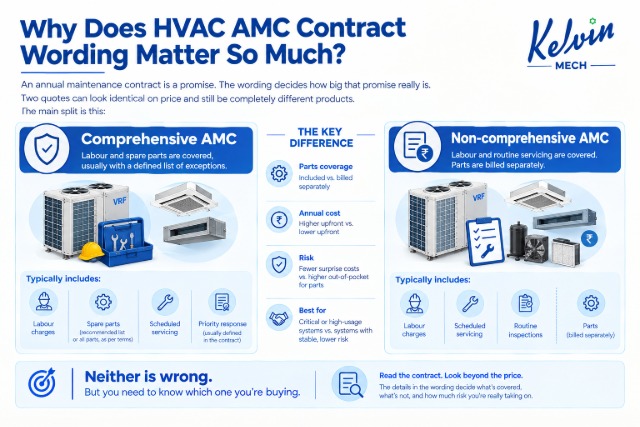
Two quotes can look identical on price and still be completely different products. The main split is this:
- Comprehensive AMC: Labour and spare parts are covered, usually with a defined list of exceptions
- Non-comprehensive AMC: Labour and routine servicing are covered. Parts are billed separately
Neither is wrong. But you need to know which one you’re buying. We’ve broken down what drives pricing in our guide to HVAC AMC costs in India, and compared the economics in AMC vs on-call repairs. This post picks up where those end: what the contract itself should say.
HVAC AMC Checklist: What Your Contract Must Include
Tick these off line by line:
- Complete asset list. Every unit, with make, model, capacity and location. If it isn’t listed, it isn’t covered
- Scheduled preventive visits. A fixed number per year per asset type, with a visit calendar
- Emergency breakdown response. Included in the contract, not billed as a separate call-out
- Filter cleaning and replacement. State which filters are cleaned, which are replaced, and how often
- Coil cleaning. Condenser and evaporator coils, including chemical wash where needed
- Refrigerant leak checks. And a clear rule on top-ups (more on that below)
- Electrical checks. Terminals, contactors, capacitors, starters and earthing
- Drain and condensate checks. Blocked drain lines cause more water damage than most people expect
- Controls and sensor calibration. Thermostats, BMS points and setpoints
- Service reports. A signed report after every visit with readings, findings and recommendations
For a benchmark, look at ASHRAE Standard 180. It sets minimum inspection and maintenance practice for commercial HVAC systems, aiming to preserve comfort, efficiency and indoor air quality. You don’t need to cite it in the contract. But a good vendor’s checklist should look similar.
How Many Service Visits Per Year Do You Need?
There’s no single answer. It depends on the system, how hard it works and how critical the space is. These are common benchmarks, not rules:
| System type | Typical visits per year |
| Split and ductable AC | 2 to 4 |
| VRF systems | 4 |
| AHUs and FCUs | 4 to 12 |
| Chillers and cooling towers | Monthly, plus daily operator logs |
| Data centre and precision cooling | Monthly or more |
Chillers deserve special attention because water-cooled plants have more to inspect, from condenser tubes to cooling towers. Our guide to air-cooled vs water-cooled chillers explains why.
Hot, dusty sites need more visits. So do buildings running 24×7. If a vendor offers one visit a year for a central plant, that’s a warning sign.
Which Exclusion Clauses Are Red Flags?
This is where contracts quietly turn against you. Watch for:
- “Parts as required” with no list. Ask exactly which parts are covered
- Refrigerant top-up charged separately, with no cap. Refrigerant costs will likely keep moving as India phases down HFCs, so settle who pays before the invoice arrives
- Compressors, PCBs and motors excluded. These are the expensive failures. Excluding them hollows out a “comprehensive” contract
- Emergency calls billed per visit. Then it isn’t really emergency cover
- Vague “wear and tear” exclusions. Almost everything is wear and tear if the vendor wants it to be
- Business-hours-only response. Fine for a small office. Not fine for a hospital or a hotel
- Auto-renewal with automatic price hikes. Read the escalation clause twice
- Unannounced subcontracting. You should know who is actually touching your equipment
What SLA Standards Should You Expect?
An SLA turns promises into numbers. Without one, “prompt response” means whatever the vendor wants it to mean.
Look for:
- Response time. Commonly 2 to 4 hours for critical breakdowns and 24 hours for non-critical ones, with the clock starting at your call or ticket
- Resolution time. A target to fix the fault, not just to show up
- Escalation path. Named contacts at each level
- Uptime commitment for critical systems
- Reporting. Monthly summaries of visits, faults and pending actions
- Penalties or service credits when the vendor misses the SLA
The stricter the site, the tighter the numbers. A data centre needs far more than an office, as we discussed in our data center HVAC guide.
What Should You Negotiate Before Signing?
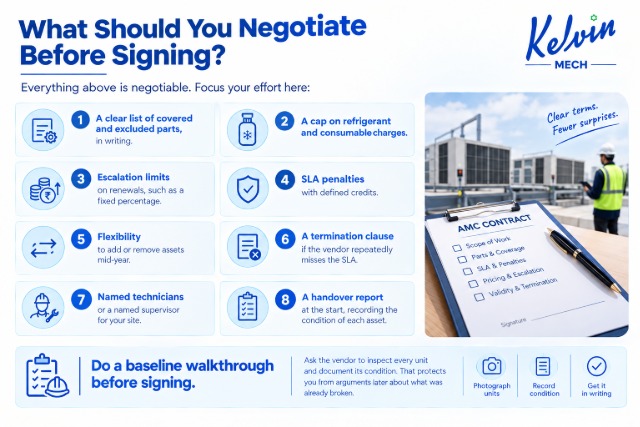
Everything above is negotiable. Focus your effort here:
- A clear list of covered and excluded parts, in writing
- A cap on refrigerant and consumable charges
- Escalation limits on renewals, such as a fixed percentage
- SLA penalties with defined credits
- Flexibility to add or remove assets mid-year
- A termination clause if the vendor repeatedly misses the SLA
- Named technicians or a named supervisor for your site
- A handover report at the start, recording the condition of each asset
Do a baseline walkthrough before signing. Ask the vendor to inspect every unit and document its condition. That protects you from arguments later about what was already broken.
Where Does Kelvin Mech Fit In?
We’d rather you read the contract carefully than sign fast. Kelvin’s HVAC annual maintenance contracts list assets, visit schedules and exclusions upfront, and our HVAC maintenance service team follows documented checklists on every visit. If your system needs design work or upgrades before an AMC makes sense, our HVAC company in Mumbai and MEP services teams can handle that under one plan.
Frequently Asked HVAC AMC Questions
What should an HVAC AMC include?
At minimum: a full asset list, scheduled preventive visits, emergency response, filter and coil cleaning, refrigerant checks, electrical checks and signed service reports.
What’s the difference between comprehensive and non-comprehensive AMC?
Comprehensive covers labour and spare parts, usually with listed exceptions. Non-comprehensive covers labour and routine servicing, with parts billed separately.
How many AMC visits per year are needed for HVAC?
Split and ductable units often need 2 to 4. VRF systems typically need around 4. Chillers and critical systems need monthly visits or more.
Is refrigerant top-up included in HVAC AMC?
Not always. Check whether top-ups are covered, capped or charged separately, and get it in writing.
Can I negotiate an HVAC AMC?
Yes. Scope, SLAs, penalties, escalation and exclusions are all negotiable, especially for multi-asset or multi-year contracts.
HVAC AMC Checklist India: Where This Leaves You
A good HVAC AMC isn’t the cheapest one. It’s the one that says exactly what happens when something goes wrong, and backs it with numbers. Clear asset lists, defined visits, honest exclusions and a real SLA protect you from surprises in peak summer, when surprises cost the most.
Before you sign, read the contract with this checklist beside it. Question every vague clause. Push back on every open-ended exclusion. A few hours of review now can save you months of disputes later.
Reviewing an existing contract or planning a new one? Talk to Kelvin’s team for a straight, no-jargon walkthrough.