Why Your HVAC Is Losing Cooling Efficiency: 8 Causes and Fixes

It’s October. The monsoon has left. The heat hasn’t.
In Mumbai, Chennai, Hyderabad, Ahmedabad and much of south, west and east India, AC systems are still running flat out. The room won’t cool. The bill keeps climbing. If your HVAC is losing cooling efficiency in India’s lingering heat, you’re not imagining it.
Systems rarely fail overnight. They fade. A little less airflow. A coil clogged with monsoon dust and damp. A few grams of lost refrigerant. Each looks small. Together they cost real money.
In this blog, Kelvin Mech – will cover 8 HVAC efficiency drop causes, what fixes each one and when to repair or replace. Let’s start with what’s going wrong.
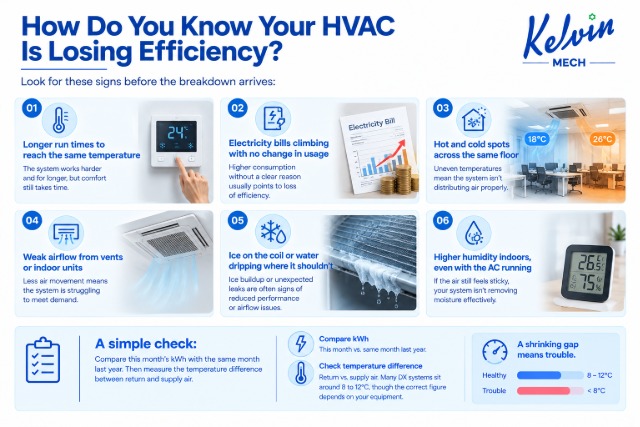
How Do You Know Your HVAC Is Losing Efficiency?
Look for these signs before the breakdown arrives:
- Longer run times to reach the same temperature
- Electricity bills climbing with no change in usage
- Hot and cold spots across the same floor
- Weak airflow from vents or indoor units
- Ice on the coil or water dripping where it shouldn’t
- Higher humidity indoors, even with the AC running
A simple check: compare this month’s kWh with the same month last year. Then measure the temperature difference between return and supply air. Many DX systems sit somewhere around 8 to 12°C, though the correct figure depends on your equipment. A shrinking gap means trouble.
Why Does October Make HVAC Problems Worse?
Post-monsoon months are tough on equipment. Four months of humidity leave coils damp, drain lines sludgy and filters loaded with dust. Mould loves a wet coil. Then the heat returns, and a system that’s already weaker has to carry the full load.
In states that stay hot well into the year, there’s no quiet season to service anything. Tamil Nadu, Kerala, Andhra Pradesh, Telangana, Karnataka, Maharashtra, Gujarat and Odisha all keep their ACs working. That makes October a smart time to diagnose problems, before they get forgotten until next April.
What Are the 8 Main HVAC Efficiency Drop Causes?
Clogged air filters
The most common cause, and the cheapest to fix. Dirty filters choke airflow and force the system to work harder. The U.S. Department of Energy says replacing a clogged filter can cut an air conditioner’s energy use by 5 to 15%. After the monsoon, filters are often loaded with damp dust. So check them monthly rather than annually.
Fix: Clean or replace filters based on site conditions, not just the calendar.
Dirty evaporator and condenser coils
Dust, debris, grease, monsoon moisture coat – these coils and block heat transfer. Outdoor condensers are hit hardest. Water-cooled systems face scaling inside condenser tubes, which we covered in our guide to air-cooled vs water-cooled chillers.
Fix: Chemical or jet wash on coils, tube cleaning on chillers and straightened fins.
Low refrigerant from leaks
Here’s a myth worth busting. Refrigerant doesn’t wear out. If the level is low, it’s leaking. A system low on charge cools badly, runs longer and can freeze its coil.
Fix: Find and repair the leak first, then recharge to the manufacturer’s specification. Topping up without fixing the leak just repeats the problem.
Duct leakage and poor insulation
Leaky or uninsulated ducts lose cooled air before it reaches the room. In ductable systems, that can be a big share of what the system produces. Rooms furthest from the unit suffer first, and damp insulation after the monsoon makes it worse.
Fix: Seal joints, repair insulation and rebalance dampers.
Worn fan motors, belts and blowers
Slipping belts, dirty blower wheels and tired motors reduce airflow even when filters are clean. You’ll often hear it before you measure it.
Fix: Replace belts and bearings, clean blower wheels and check motor current against nameplate values.
Ageing compressors
Compressors lose capacity as valves and windings wear. Symptoms include higher amp draw, longer cycles and rising discharge temperatures. Electrical problems like voltage imbalance and loose terminals speed this up, as we explained in our piece on electrical MEP services.
Fix: Check the electrical supply first. Then decide between overhaul and replacement (more on that below).
Thermostat and sensor drift
Sensors lose accuracy over time. A thermostat reading 2°C off can cause overcooling, wasted energy and unhappy occupants. In buildings with a BMS, drifting sensors can mislead the whole control logic.
Fix: Calibrate sensors at least once a year and check setpoints and schedules.
Changed building loads
This one gets overlooked. Your system was sized for the building as it was. Since then you’ve added people, servers, kitchens, glass or extra floors. The equipment hasn’t failed. It’s just undersized for today’s load. Retail and high-footfall spaces see this often, as we covered in our shopping mall HVAC guide. Festive season crowds make it more obvious.
Fix: Recalculate the heat load, then rebalance, add zoning or add capacity.
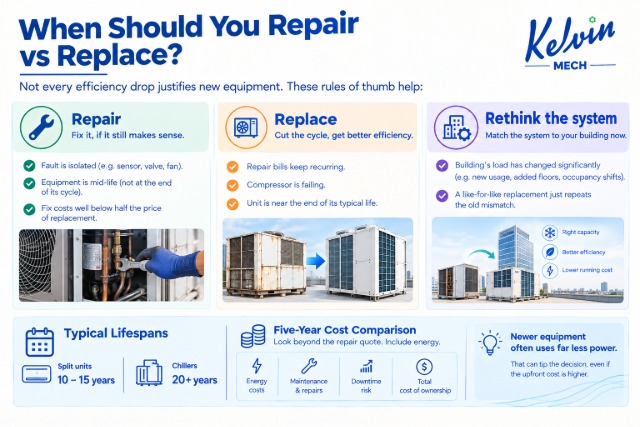
When Should You Repair vs Replace?
Not every efficiency drop justifies new equipment. These rules of thumb help:
- Repair when the fault is isolated, the equipment is mid-life and the fix costs well below half the price of replacement
- Replace when repair bills keep recurring, the compressor is failing and the unit is near the end of its typical life
- Rethink the system when the building’s load has changed significantly, since a like-for-like replacement just repeats the old mismatch
Typical lifespans vary. Split units often run 10 to 15 years, while well-maintained chillers can last 20 years or more. Ask for a cost comparison over five years, including energy, not just the repair quote. Newer equipment often uses far less power, which can tip the decision.
How Do You Stop the Decline From Starting Again?
Efficiency loss is gradual, so the answer is routine. ASHRAE Standard 180 sets minimum inspection and maintenance practice for commercial HVAC systems, aiming to preserve comfort, efficiency and air quality. A structured plan matters more than any single fix. If you’re unsure what a plan should cost, our breakdown of HVAC AMC costs in India will help.
Where Does Kelvin Mech Fit In?
Kelvin’s HVAC maintenance service team diagnoses efficiency drops with measurements, not guesses. A scheduled HVAC annual maintenance plan keeps filters, coils and controls in check. If your load has changed, our HVAC company in Mumbai can recalculate and redesign. And our MEP services team handles electrical issues that quietly drag performance down.
Frequently Asked HVAC Efficiency Questions
Why is my HVAC losing cooling efficiency?
Usually a mix of dirty filters, fouled coils, low refrigerant, weak airflow and changed building loads. Start with filters and coils, since they’re cheapest to fix.
Is October a good time for HVAC servicing in India?
Yes, especially in states that stay hot. Post-monsoon dust, damp and mould show up now, and fixing them early protects you through the rest of the warm months.
Does low refrigerant mean there’s a leak?
Yes. Refrigerant isn’t consumed, so low charge points to a leak somewhere in the circuit.
How often should HVAC filters be cleaned in India?
Monthly checks work well in dusty, humid or high-use sites. Clean or replace them when they’re visibly loaded, not just on schedule.
HVAC Efficiency Drop Causes: Where This Leaves You
Efficiency doesn’t vanish overnight. It leaks away through dirty filters, fouled coils, small refrigerant losses and drifting sensors. The good news is that most causes are cheap to fix when caught early, and expensive when ignored through months of heat and humidity.
Start with the basics. Check filters, clean coils, track your bills and measure temperature differences. Bring in professionals for refrigerant, compressors and load calculations. With the monsoon behind you and the heat still here, now is the time to catch problems before they cost you another quarter of high bills.
Seeing the warning signs in your building? Talk to Kelvin’s team and get a proper diagnosis.