Building Management System: Does Your HVAC Actually Need One?
Chillers running. AHUs running. Lights on across an empty floor. Nobody knows why.
That’s a building without visibility. And it’s exactly the problem a building management system solves. But does every building need one? Honestly, no.
A building management system (BMS) ties your HVAC, lighting, power and safety systems into one dashboard. Done right and it can cut energy waste and flag faults before they become breakdowns. Done wrong and it becomes expensive screen nobody opens. With October heat keeping AC loads high across much of India, that waste adds up fast.
This guide from Kelvin Mech – famous for ventilation design and contracting services in Andheri – will explain what a BMS does, how it works with HVAC and how to tell if your building is ready.
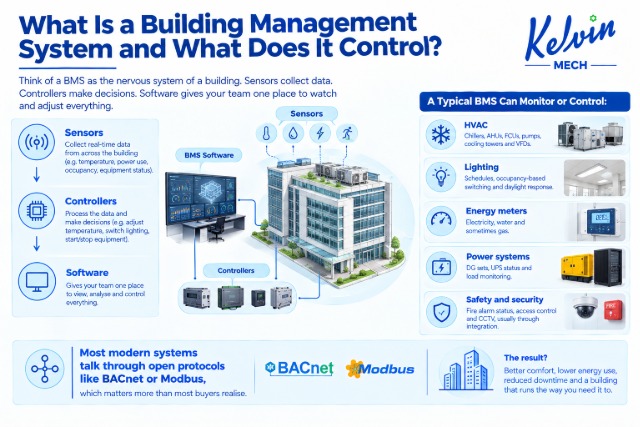
What Is a Building Management System and What Does It Control?
Think of a BMS as the nervous system of a building. Sensors collect data. Controllers make decisions. Software gives your team one place to watch and adjust everything.
A typical BMS can monitor or control:
- HVAC: chillers, AHUs, FCUs, pumps, cooling towers and VFDs
- Lighting: schedules, occupancy-based switching and daylight response
- Energy meters: electricity, water and sometimes gas
- Power systems: DG sets, UPS status and load monitoring
- Safety and security: fire alarm status, access control and CCTV, usually through integration
Most modern systems talk through open protocols like BACnet or Modbus, which matters more than most buyers realise (more on that shortly).
How Does HVAC Integrate With a BMS?
HVAC is usually the biggest reason a building installs a BMS. It’s also the biggest energy user, so the logic is simple: control the largest load better.
Here’s how the pieces connect:
- Sensors measure temperature, humidity, CO2, pressure and flow
- DDC controllers read those values and run control logic
- Actuators and VFDs adjust valves, dampers and fan or pump speeds
- BMS software logs everything, raises alarms and lets operators change setpoints
What does that give you in practice?
- Equipment runs only when needed, on schedules that match real occupancy
- Chilled water temperature resets based on demand, instead of staying fixed
- Chillers sequence intelligently. Our guide to air-cooled vs water-cooled chillers explains why plant design matters here
- CO2 sensors adjust fresh air so you don’t over-ventilate
- Alarms and trend logs catch problems early, like a coil losing performance
Standalone vs Integrated BMS: What’s the Difference?
Not every BMS has to run the whole building.
- Standalone (HVAC-only): Controls just the cooling and ventilation. Simpler, cheaper and fine when HVAC is your main concern
- Integrated: Brings HVAC, lighting, power, fire and access into one platform. Costs more but gives a single view and smarter cross-system logic
Integrated systems pay off in big, complex buildings. Power and electrical integration in particular needs proper planning, as we covered in our piece on electrical MEP services.
One warning. Insist on open protocols. A proprietary system can lock you into one vendor for upgrades, service and spares for the life of the building.
What Is the ROI of a BMS on Energy Savings?
Let’s be careful here, because vendor brochures love big numbers.
A US study by Pacific Northwest National Laboratory found that properly tuned building controls could cut commercial building energy use by about 29% on average. That’s a national potential for American buildings, not a promise for yours. Indian buildings differ in climate, usage and how well systems get tuned after installation.
The savings usually come from a handful of sources:
- Better scheduling, so nothing runs in empty spaces
- Tighter setpoints and temperature resets
- Optimised chiller and pump operation
- Faster detection of faults that waste energy
Use a conservative number for your own business case. A quick example: if your annual HVAC electricity cost is ₹60 lakh and a BMS delivers 10% savings, that’s ₹6 lakh a year. Compare that with the installed cost, plus licences and support, to estimate payback. In regions where the cooling season stretches well into October and beyond, a longer cooling season gives savings more months to build.
India’s Energy Conservation Building Code also pushes new commercial buildings towards efficient HVAC and controls, so a BMS can support compliance goals too.
Is Your Building Too Small, or Right-Sized, for a BMS?
A BMS isn’t a badge of quality. It’s a tool. Here’s a fair test.
Probably too small if:
- You have a single floor or a few split ACs
- There’s no central plant and few zones
- Simple timers or smart thermostats already do the job
Probably right-sized if:
- You run a central chilled water plant with multiple AHUs
- The building has several floors, tenants or zones
- Operations run 24×7, like hotels, hospitals and campuses
- Failure is expensive, as in data centres, labs and factories. We covered those stakes in our data center HVAC guide
The grey zone: VRF buildings come with their own central controllers. Add a BMS when you want monitoring across other systems, not just to manage the VRF.
A useful question: can you tell, right now, what your cooling plant is doing without walking to the plant room? If not, a BMS deserves a look.
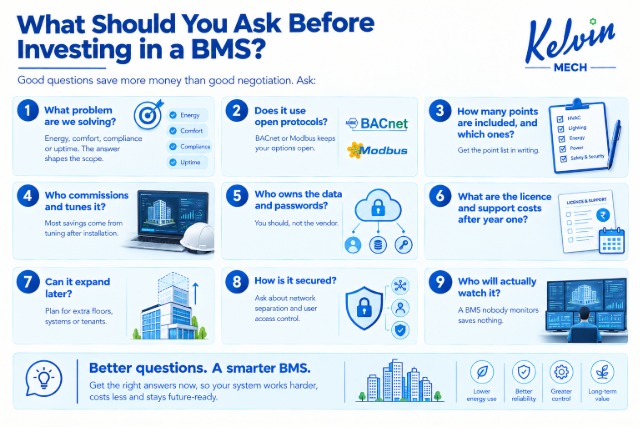
What Should You Ask Before Investing in a BMS?
Good questions save more money than good negotiation. Ask:
- What problem are we solving? Energy, comfort, compliance or uptime. The answer shapes the scope
- Does it use open protocols? BACnet or Modbus keeps your options open
- How many points are included, and which ones? Get the point list in writing
- Who commissions and tunes it? Most savings come from tuning after installation
- Who owns the data and passwords? You should, not the vendor
- What are the licence and support costs after year one?
- Can it expand later? Plan for extra floors, systems or tenants
- How is it secured? Ask about network separation and user access control
- Who will actually watch it? A BMS nobody monitors saves nothing
Where Does Kelvin Mech Fit In?
BMS is a core part of what we do alongside industrial HVAC and MEP contractors. We design controls around how your building really runs, then back them with HVAC maintenance and a scheduled HVAC annual maintenance plan, so the savings last.
If your hotel or hospitality property is considering one, our guide on hotel HVAC systems shows where controls matter most.
Frequently Asked BMS Questions
What is a building management system?
A BMS is a central control and monitoring system for a building’s HVAC, lighting, power and other services, built on sensors, controllers and software.
Is a BMS the same as a BAS?
The terms are often used interchangeably. Some people use BMS for the broader system and building automation system (BAS) for the control layer.
Does a VRF system need a BMS?
Not necessarily. VRF has its own controller. Add a BMS if you want wider monitoring, reporting or integration with other systems.
How much energy can a BMS save?
It depends on the building and how well the system is tuned. Studies show large potential, but real savings vary. Plan with conservative numbers.
Building Management System: Where This Leaves You
A BMS isn’t magic and it isn’t a must-have for every building. For small spaces with a few ACs, it can be overkill. For buildings with central plants, many zones and long operating hours, it’s often one of the smartest investments you can make.
The key is to be honest about your goals. Pick open systems. Get the scope in writing. Plan for tuning and support, not just installation. And make sure someone owns the dashboard once it’s live.
Weighing a BMS for your building? Talk to Kelvin’s team and get a straight answer on whether it pays off.