Air vs Water-Cooled Chillers in India: How to Choose for a Facility
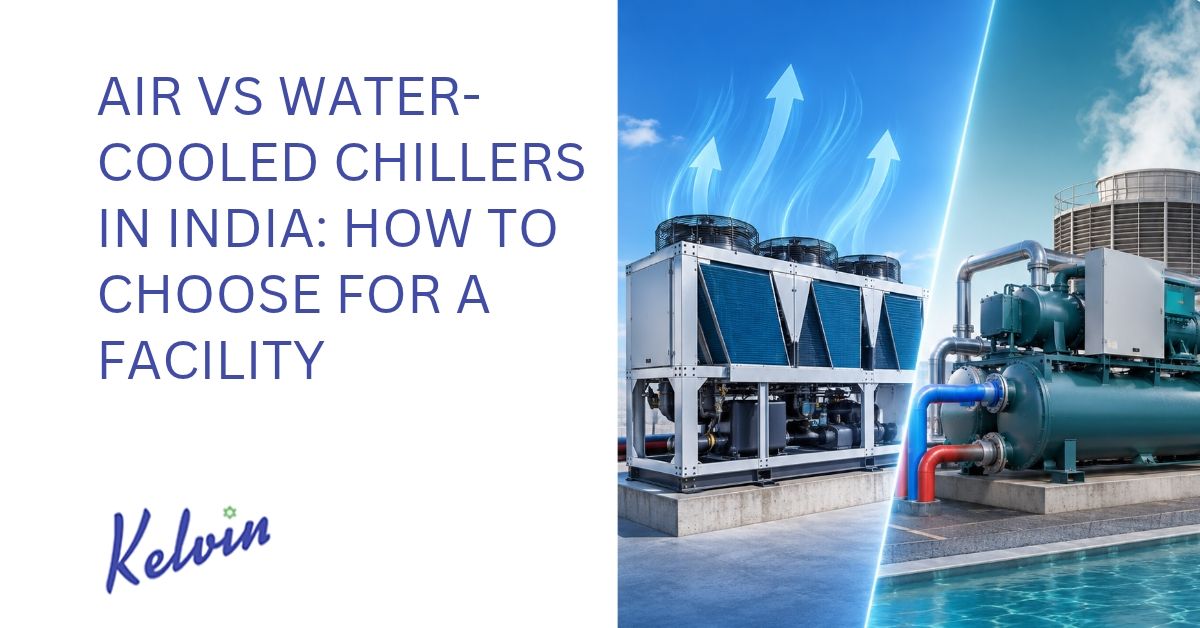
Chillers don’t get a summer break. Not in India. Not even in October.
India’s peak power demand hit a record of roughly 270 GW in May, and cooling was a big reason. Your chiller is one of the biggest power users in your building. Pick the wrong type and you pay for it every month, for twenty years.
So, air-cooled vs water-cooled chillers. Which one fits your facility? There’s no universal answer. But there is a smart way to decide.
This guide from Kelvin Mech – best HVAC company in India – compares both on efficiency, water, cost, space and maintenance. You’ll also get a facility-by-facility guide and the questions to ask before you approve a design.
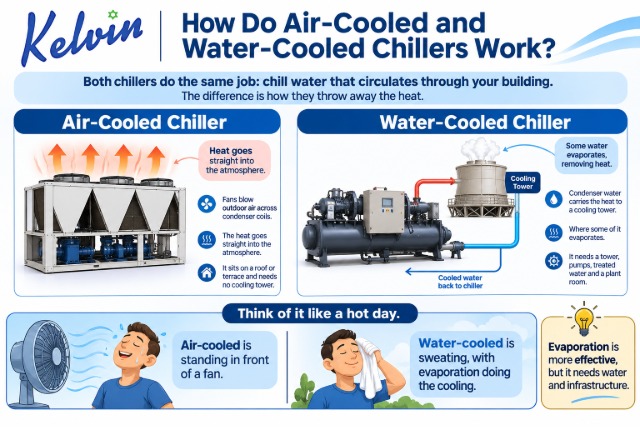
How Do Air-Cooled and Water-Cooled Chillers Work?
Both chillers do the same job: chill water that circulates through your building. The difference is how they throw away the heat.
- Air-cooled chiller: Fans blow outdoor air across condenser coils. The heat goes straight into the atmosphere. It sits on a roof or terrace and needs no cooling tower
- Water-cooled chiller: Condenser water carries the heat to a cooling tower, where some of it evaporates. It needs a tower, pumps, treated water and a plant room
Think of it like a hot day. Air-cooled is standing in front of a fan. Water-cooled is sweating, with evaporation doing the cooling. Evaporation is more effective, but it needs water and infrastructure.
Air Cooled Chiller vs Water Cooled Chiller: Head-to-Head
| Factor | Air-cooled | Water-cooled |
|---|---|---|
| Energy efficiency | Lower, drops in extreme heat | Higher, especially at large scale |
| Upfront cost | Lower for small and mid plants | Higher (tower, pumps, piping, plant room) |
| Water use | Almost none | Significant, for the cooling tower |
| Space | Roof or terrace footprint | Plant room plus tower |
| Maintenance | Simpler, fewer parts | More equipment and water treatment |
| Typical lifespan | Shorter | Often longer |
| Best for | Small to medium loads, water-scarce sites | Large, 24×7 and high-load sites |
The table is the quick answer. The real decision lives in the details below.
Which Chiller Costs Less to Run in India?
Water-cooled usually wins on running cost, and the gap is big. As a rough benchmark, air-cooled chillers often draw somewhere between 1.1 and 1.4 kW per tonne at full load, while water-cooled plants can run around 0.55 to 0.8 kW per tonne. Your actual numbers depend on the make, load profile and ambient conditions, so ask vendors for rated performance at your site.
Why does this matter now? Cooling is shaping India’s electricity story. The International Energy Agency notes that demand reached a record of about 270 GW on 21 May, and a UC Berkeley study found that room air conditioners alone already account for 60 to 70 GW of peak demand. Commercial chillers sit on top of that. Higher tariffs, demand charges and grid stress all make efficiency more valuable every year.
But efficiency isn’t the whole story. A higher upfront cost for a water-cooled plant pays back only if the chillers run enough hours. For a facility with lighter, seasonal use, an air-cooled chiller can win on total cost.
What About Water? The Question Nobody Budgets For
Water-cooled chillers only look cheap until you count the water. Cooling towers lose water through evaporation, drift and blowdown, and they need chemical treatment to control scale and bacteria like Legionella.
In water-stressed cities, that matters. If your site depends on tanker water or faces municipal restrictions, make sure a cooling tower is realistic before you commit. Many large facilities use treated sewage water for the tower, which helps, but it adds treatment equipment and monitoring.
Air-cooled chillers avoid the whole question. That’s why they’re popular in dry regions, rooftop installations and sites where water is expensive or unreliable.
How Do Climate and Size Change the Answer?
Climate. Water-cooled efficiency depends on the wet-bulb temperature, and air-cooled depends on the dry-bulb. In hot, dry regions, the gap between the two is large, so water-cooled has a big advantage. In humid coastal cities, the wet-bulb is already high, so the advantage shrinks. And above roughly 45°C, air-cooled units lose capacity and may trip on high pressure, so check ratings at your peak ambient.
Size. As a rough rule, air-cooled suits smaller loads, up to a few hundred tonnes. Beyond that, water-cooled becomes more economical, and above about a thousand tonnes it’s usually the default. Plenty of plants also go hybrid, with air-cooled units for backup or base load and water-cooled for the bulk.
Which Chiller Suits Which Facility?
- Hospitals and large campuses: Water-cooled usually wins. Long operating hours and high loads reward efficiency
- Data centres: Water-cooled for large halls, air-cooled for smaller ones. Reliability matters most, as we covered in our data center HVAC guide
- Hotels: Often water-cooled for efficiency, with attention to space and noise, as in our hotel HVAC systems guide
- Malls and large offices: Water-cooled for scale, though water supply and tower space need checking. Our shopping mall HVAC guide goes deeper
- Small and mid-size offices, clinics, light industry: Air-cooled is often simpler and cheaper overall
- Water-scarce or roof-only sites: Air-cooled, almost by default
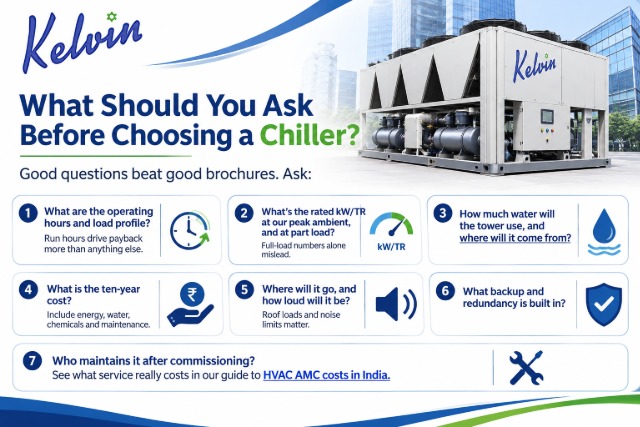
What Should You Ask Before Choosing a Chiller?
Good questions beat good brochures. Ask:
- What are the operating hours and load profile? Run hours drive payback more than anything else
- What’s the rated kW/TR at our peak ambient, and at part load? Full-load numbers alone mislead
- How much water will the tower use, and where will it come from?
- What is the ten-year cost? Include energy, water, chemicals and maintenance
- Where will it go, and how loud will it be? Roof loads and noise limits matter
- What backup and redundancy is built in?
- Who maintains it after commissioning? See what service really costs in our guide to HVAC AMC costs in India
Where Does Kelvin Mech Fit In?
Chillers are a core part of what we do. Kelvin’s HVAC company in Mumbai team sizes plants around your load and ten-year cost, not a catalogue. Our MEP services cover the power, piping and plant room side, and our HVAC maintenance service and HVAC annual maintenance plans keep the plant efficient year after year.
Frequently Asked Chiller Questions
Which is more efficient, an air cooled or water cooled chiller?
Water-cooled chillers are generally more efficient, especially at larger scale. Air-cooled chillers lose efficiency as outdoor temperatures climb.
Is a water-cooled chiller worth the extra cost?
Often, for large loads and long operating hours. For smaller or seasonal loads, the savings may not justify the added tower, pumps and plant room.
Do air-cooled chillers work in Indian summers?
Yes, but capacity drops in extreme heat. Check ratings at your site’s peak temperature and size accordingly.
What about an air cooled and water cooled chiller hybrid plant?
It’s a common approach. Air-cooled units cover backup or low-load periods, while water-cooled units handle the main load.
Air-Cooled vs Water-Cooled Chillers: Where This Leaves You
Neither chiller is better in every case. Water-cooled wins on efficiency, scale and long-term running cost. Air-cooled wins on simplicity, water independence and lower upfront cost. The right answer comes from your load, your hours, your water supply and your ten-year budget.
Run the numbers before you pick. A small difference in kW per tonne becomes a very large number across thousands of hours and decades of use. With cooling demand still setting records, the efficiency you design in today decides what you pay for years.
Choosing a chiller for a new building or a replacement? Talk to Kelvin’s team and get a recommendation built on your actual numbers.