Dry Room HVAC for Battery and Gigafactory Plants: Everything Covered
One drop of moisture. That’s all it takes. Inside a lithium-ion cell, water reacts with the electrolyte and can form hydrofluoric acid. Cells degrade. Yields drop. Batches get scrapped.
That’s why dry room HVAC sits at the heart of every battery plant. We’re not talking about 50% humidity, or even 10%. We’re talking dew points of minus 40°C and lower. Air so dry it feels unreal.
As India builds its first gigafactories, facility heads and EPC teams are learning one thing fast. A dry room is not a bigger AC. It’s a different machine. This guide from Kelvin Mech – Industrial HVAC leader – explains how it works, why it eats so much power and what to demand from your HVAC partner.
Why Do Battery Plants Need a Dry Room at All?
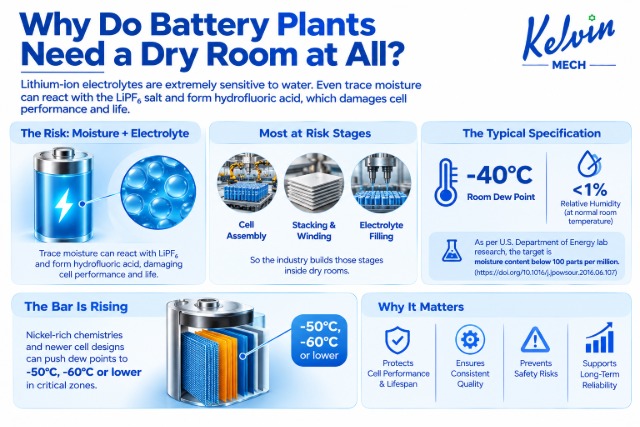
Lithium-ion electrolytes are extremely sensitive to water. Even trace moisture can react with the LiPF₆ salt and form hydrofluoric acid, which damages cell performance and life. The stages most at risk are cell assembly, stacking and winding, and especially electrolyte filling.
So the industry builds those stages inside dry rooms. A common specification is a room dew point of -40°C, which means relative humidity below 1% at normal room temperature. Research from a U.S. Department of Energy lab describes the target as moisture content below 100 parts per million.
And the bar is rising. Nickel-rich chemistries and newer cell designs can push dew points to -50°C, -60°C or lower in critical zones.
What Does Near-Zero Dew Point Actually Mean?
Dew point is the temperature at which water vapour starts to condense. The lower it is, the less moisture the air holds. Here’s the scale:
| Room dew point | Moisture in the air (approx.) |
|---|---|
| -40°C | 0.08 g per kg of dry air |
| -60°C | 0.007 g per kg of dry air |
| 30°C and 70% RH (typical humid Indian day) | about 19 g per kg of dry air |
Look at the gap. Humid Indian air carries more than 200 times the moisture of a -40°C dry room, and nearly 3,000 times that of a -60°C one. Your HVAC has to remove almost all of it, every hour, all year round, including post-monsoon weeks when coastal and southern India stays damp.
How Does Dry Room HVAC Work?
A normal cooling coil can’t get there. Cooling air to dew points like -40°C would freeze the coil long before it got close. Dry rooms use desiccant dehumidification instead. Here’s the chain:
- Fresh air pre-cooling: Chilled water coils remove the bulk of the moisture from outside air first
- Desiccant rotor: A slowly rotating wheel adsorbs moisture from the air. Silica gel works well down to roughly -30°C, while molecular sieve or hybrid rotors handle lower dew points
- Regeneration: Hot air, often around 140 to 155°C, drives the moisture out of the wheel so it can keep working
- Post-cooling: Dry air is cooled back to the supply temperature the process needs
- Supply and return: Very dry air enters through filters, and room air returns to be mixed with fresh air and dried again
- Positive pressure and airlocks: The room stays pressurised relative to surrounding areas, with airlocks and pass boxes at every entry
This is precision-first thinking, similar to what we describe in our guide to semiconductor fab HVAC. The difference is that moisture, not particles, is the main enemy.
Where Does Moisture Come From?
Knowing the sources tells you how to size the system and where to save energy. In a dry room, the main moisture loads are:
- People: Every worker adds moisture through breathing and perspiration, usually the largest internal load
- Airlock openings: Each door cycle lets in humid air
- Infiltration: Leaks through walls, ceilings, penetrations and joints
- Makeup air: Fresh air needed for ventilation and to replace exhaust
- Materials and equipment: Components carry moisture in with them
That’s why serious dry room design focuses on the envelope. Vapour barriers, sealed penetrations, well-designed airlocks and automation that keeps people out of the room all cut the load before the dehumidifier ever sees it.
Why Is Dry Room HVAC So Energy-Hungry?
Dry rooms are among the heaviest energy users in a cell plant. The UK Battery Industrialisation Centre’s white paper lists electrode drying, formation and ageing, and dry rooms as the three largest energy-consuming areas in cell manufacturing. Published estimates of the dry room’s share vary widely by plant, chemistry and design, so work from your own load calculation rather than a headline percentage.
The reasons are simple. Regeneration needs a lot of heat. Fresh air must be dried and cooled continuously. And the colder the dew point, the harder the system works, so going from -40°C to -60°C doesn’t add a little energy. It can add a lot.
Where can you save?
- Right-size dew points by zone. Don’t dry every room to the strictest spec
- Cut the load first. Tight envelopes, fewer people, fewer door openings
- Recover heat. Use waste heat for regeneration where possible
- Choose efficient desiccant and purge technology
- Control it properly. Continuous dew point monitoring and trending catch drift early
When comparing offers, ask for energy per unit of dry air delivered, not just the dew point promised.
What Should You Ask Your Dry Room HVAC Contractor?
A dry room is an expensive, unforgiving space. Ask these before you commit:
- Which dew point does each zone actually need? Let the process team set it, not the vendor
- What’s the moisture load calculation based on? Occupancy, airlock cycles, leakage rates and makeup air should all be listed
- What’s the total energy per unit of dry air? Include regeneration, cooling and fans
- What redundancy is built in? A single dehumidifier failure can scrap a shift’s output
- Which ambient design conditions did you use? Insist on peak humid conditions for your site, not average ones
- How will the envelope and airlocks be designed and tested?
- How are dew point sensors selected and calibrated? Drift here means false confidence
- Who commissions, validates and maintains it? Plan this early. Our guide to HVAC AMC costs in India will help you budget

What Makes India a Special Case?
Indian sites face humid coastal air, heavy monsoon loads, dust and variable grid quality. Humidity drives the latent load, so design for the worst day, not the typical one. Power quality matters too, since desiccant rotors, heaters and controls all need stable supply. Our guide to electrical MEP services explains why the electrical design should be coordinated with HVAC from day one.
Critical, always-on facilities have similar stakes, as we covered in our data center HVAC guide. The lesson carries over: redundancy and monitoring aren’t extras.
Where Does Kelvin Mech Fit In?
Dry rooms demand the same discipline as cleanrooms: precise design, clear documentation and a maintenance plan that keeps performance from drifting. Kelvin’s HVAC company in Mumbai team and one of the best MEP contracting companies in India group can work with your process team and dehumidifier supplier on the surrounding systems. Afterwards, our air handling unit maintenance and annual HVAC maintenance plans help keep conditions stable.
Frequently Asked Dry Room HVAC Questions
What dew point does a lithium-ion battery dry room need?
Commonly -40°C, equal to under 1% relative humidity. Some chemistries and process steps need -50°C, -60°C or lower.
Is a dry room the same as a cleanroom?
No. A cleanroom controls particles. A dry room controls moisture, though battery dry rooms often need both.
Why can’t a normal chiller or AC make a dry room?
Cooling coils can’t reach such low dew points without freezing. Desiccant dehumidifiers are used instead.
Why do dry rooms use so much energy?
Regenerating the desiccant, drying fresh air and holding very low humidity continuously all take heat and power. The lower the dew point, the more it takes.
Dry Room HVAC: Where This Leaves You
A dry room is one of the most demanding environments you’ll ever condition. The moisture targets are extreme, the energy bills are large and the cost of an excursion is a scrapped batch. That makes design discipline more valuable than any single piece of equipment.
Start with the process. Set realistic dew points zone by zone. Cut the moisture load before you buy dehumidifiers. Insist on redundancy, monitoring and a maintenance plan. Plants that do this keep yield high and energy costs predictable.
Planning a battery or gigafactory project? Talk to Kelvin’s team about the supporting HVAC and MEP systems.