Precision HVAC for India’s Semiconductor Fabs and Cleanrooms

Somewhere in Dholera or Sanand right now, a wafer worth more than most cars is sitting inside a room where temperature swing is measured in fractions of a degree. Not because someone’s being fussy. But because a temperature drift of even half degree Celsius can throw off a chemical process step enough to ruin an entire production batch.
This is the world India’s semiconductor push has walked into. And it’s a world where HVAC isn’t a comfort system anymore. It’s process infrastructure.
For decades, HVAC in India meant keeping offices cool and factories bearable. Semiconductor fabs flip that logic entirely. Here, HVAC system is arguably as critical to the product as machines doing the actual chip fabrication.
Why Semiconductor Fabs Need a Completely Different Kind of HVAC?
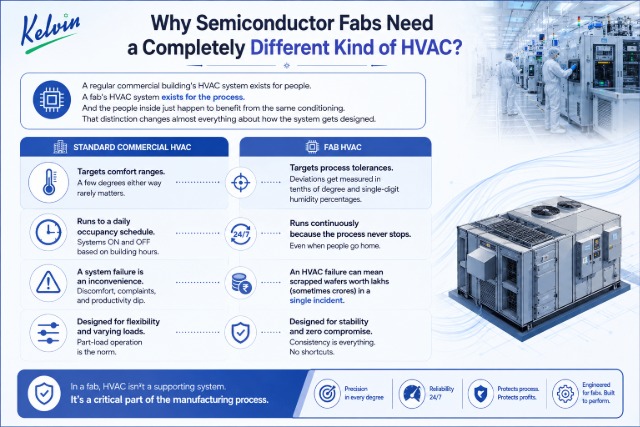
A regular commercial building’s HVAC system exists for people. A fab’s HVAC system exists for the process. And the people inside just happen to benefit from the same conditioning. That distinction changes almost everything about how the system gets designed:
- Standard commercial HVAC targets comfort ranges. A few degrees either way rarely matters
- Fab HVAC targets process tolerances. Deviations get measured in tenths of degree and single-digit humidity percentages
- Commercial systems run to a daily occupancy schedule. Fab systems run continuously because the process never stops. Even when people go home
- A commercial system failure is an inconvenience. A fab HVAC failure can mean scrapped wafers worth lakhs (sometimes crores) in a single incident
It’s a similar principle to what we’ve written about with data center HVAC – environments engineered around equipment and process, not human comfort – except a fab pushes those same demands several levels further.
What Precision Climate Control Actually Means Inside a Fab?
Precision gets used loosely in HVAC marketing. Inside a fab, it has actual, measurable meaning.
Temperature stability
Most semiconductor cleanrooms are held within roughly ±0.5°C of a setpoint Sometimes, tighter for lithography zones. That level of stability calls for dedicated air handlers, close-coupled chilled water loops, and control systems reacting in real time. Not the kind of thermostat cycling a typical commercial AC uses.
Humidity control
Relative humidity in a fab is usually held close to 45-50. Often within a ±5% band. Too much moisture affects resist adhesion and dopant diffusion during wafer processing; too little increases static buildup, which is its own contamination risk during photolithography.
Airborne particle control (ISO Cleanroom Classes)
Fabs are classified using the ISO 14644-1 standard. For those unaware, it defines air cleanliness by number of particles permitted per cubic metre of air, from ISO Class 1 (strictest) to ISO Class 9.
A typical fab cleanroom running at ISO Class 5 allows no more than a few thousand particles of 0.5 microns or larger per cubic metre. A number so small it’s genuinely hard to picture until you remember a single human hair is roughly 50-70 microns wide.
Pressure cascades
Cleanrooms are kept at higher air pressure than surrounding spaces in carefully engineered stages so air only ever flows outward from the cleanest zone to the least clean. Never the reverse! Get this cascade wrong and contaminated air can migrate straight into the space you’re trying hardest to protect.
India’s Semiconductor Boom Is Creating a New Category of HVAC Demand
This isn’t a theoretical market anymore. According to Invest India‘s overview of the Semicon India Mission, Tata Electronics’ fab in Dholera – being built with Taiwan’s PSMC – represents an investment of roughly 91,000 crore INR with a planned capacity of 50,000 wafers a month. Making it one of the most advanced facilities under development in the country.
Micron’s ATMP facility in Sanand adds another layer to that same ecosystem, and several more OSAT and packaging units are now operational or under construction across Gujarat and beyond.
Here’s why that matters to HVAC engineers specifically, not just chip manufacturers:
- Every one of these facilities needs cleanroom-grade air handling built to fab tolerances, not commercial-grade specifications
- India doesn’t have decades of domestic fab-HVAC expertise the way Taiwan, Korea, or the US do – this is a genuinely new build-out of both infrastructure and skilled capacity
- Facilities are being built at speed, which puts pressure on HVAC design and commissioning timelines that used to have years of runway
- Once operational, these systems can’t go down for retrofits — maintenance has to happen without disrupting a live, continuous process
What Are Engineering Challenges Unique to Indian Fab Sites?
Designing fab-grade HVAC in India isn’t a copy-paste of a system built for a cooler, drier climate. A few realities shape almost every project:
- Ambient temperatures regularly cross 40°C in summer across most of the states building fabs today, pushing cooling loads well above what similar facilities face elsewhere
- Monsoon humidity swings are extreme, which makes dehumidification a year-round design priority rather than a seasonal one
- Dust and particulate loads in the outside air are typically higher than in many established fab regions, putting more strain on pre-filtration stages
- Grid power reliability varies by region, which makes backup power design inseparable from HVAC design in a fab context
Why Can’t Fabs Afford a Single Point of Failure?
A cleanroom losing power for even a few minutes isn’t like an office losing power. Pressure cascades collapse, temperature and humidity start drifting immediately, and depending on the process stage, an entire batch of wafers can be compromised.
This is exactly where HVAC design and electrical MEP planning have to be treated as one problem, not two separate scopes handed to two separate teams. We’ve covered this overlap in more depth in our piece on electrical MEP services — backup power, UPS systems, and automatic transfer switches aren’t optional extras in a fab; they’re part of the climate-control system itself, because the moment power drops, so does control over the environment.
Common Mistakes in Cleanroom HVAC Design
A few patterns show up repeatedly in projects that run into trouble later:
- Sizing chillers and air handlers for average conditions instead of India’s genuine summer peak loads
- Treating the choice between air-cooled and water-cooled chillers as a purely cost decision, without factoring in water availability and long-term operating efficiency at fab scale
- Under-specifying pre-filtration, which shortens the life of the far more expensive HEPA and ULPA filters downstream
- Skipping redundancy on critical air handling units, assuming a single unit “should be enough” until it isn’t
- Not accounting for airflow management around dense equipment layouts – a challenge we’ve written about in the context of computer room air handler performance, which shares a lot of the same underlying airflow logic as a fab floor
Where Kelvin Mech Fits In?
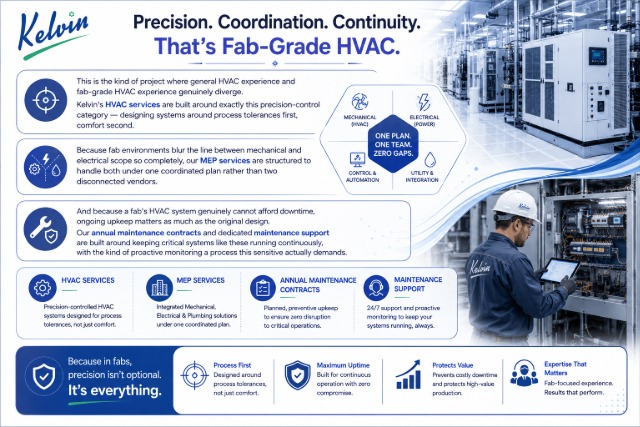
This is the kind of project where general HVAC experience and fab-grade HVAC experience genuinely diverge. Kelvin’s HVAC company in Mumbai is built around exactly this precision-control category. Designing systems around process tolerances first, comfort second. Because fab environments blur the line between mechanical and electrical scope so completely, our MEP services are structured to handle both under one coordinated plan rather than two disconnected vendors.
And because a fab’s HVAC system genuinely cannot afford downtime, ongoing upkeep matters as much as the original design. Our HVAC annual maintenance contracts and dedicated HVAC maintenance service and support are built around keeping critical systems like these running continuously, with the kind of proactive monitoring a process this sensitive actually demands.
Frequently Asked Semiconductor HVAC Questions
Why can’t semiconductor fab use standard commercial HVAC systems?
Because fab’s HVAC exists to protect an ultra-sensitive manufacturing process. Not just human comfort. It needs far tighter temperature, humidity, and particle control than any commercial building requires.
What temperature and humidity range do semiconductor cleanrooms typically require?
Most fabs hold temperature within about ±0.5°C of setpoint and relative humidity around 45–50% often within a ±5% band. Though exact tolerances vary by process step.
What does ISO Class 5 mean for a cleanroom?
It’s one of the stricter tiers under the ISO 14644-1 standard, permitting only a few thousand particles of 0.5 microns or larger per cubic metre of air. A level of cleanliness far beyond typical industrial or commercial spaces.
Why is backup power considered part of HVAC design for a fab?
Because a power interruption immediately disrupts pressure cascades, temperature, and humidity control. In a fab, electrical redundancy and climate stability are functionally the same problem.
How is India’s climate a bigger challenge for fab HVAC than in other countries?
High summer temperatures, intense monsoon humidity, and higher ambient dust levels all increase cooling, dehumidification, and filtration loads well beyond what fabs in cooler, drier regions typically face.
Should chiller selection for a fab be based mainly on upfront cost?
No. Water-cooled and air-cooled chillers carry very different long-term efficiency, water-availability, and maintenance implications at fab scale, and the wrong choice can cost far more over the system’s lifetime than it saves upfront.
HVAC Semiconductor: Where This Leaves You
India’s semiconductor build-out isn’t just creating demand for more HVAC tonnage — it’s creating demand for a category of engineering precision the country’s HVAC industry has rarely had to deliver at this scale before. Getting it right the first time matters more here than almost anywhere else in commercial construction, because the cost of getting it wrong isn’t discomfort. It’s a scrapped batch of wafers that took weeks to produce.
Building or upgrading a fab-grade HVAC system? Talk to Kelvin’s MEP and HVAC team about designing for the tolerances your process actually needs.
[…] wrote about the same “process first, people second” logic in our guide to semiconductor precision HVAC. Pharma sits in the same family, just with different […]