HVAC in Pharmaceutical Industry: GMP Rules, Zoning and More
A tablet batch gets flagged. Humidity crept up two points overnight. Nobody noticed until the QC review. That’s how small HVAC misses turn into big pharma problems.
HVAC in pharmaceutical industry facilities isn’t about comfort. It’s a GMP control. Air cleanliness, pressure, temperature and humidity all shape product quality. And Revised Schedule M now binds every manufacturing unit in India. Inspectors want proof your HVAC in pharma plant works, is validated and stays that way. Not promises. Evidence.
In this blog, Kelvin Mech – one of the HVAC contractors in Mumbai – will tell you what the rules expect, how zoning works across API and packaging areas, and questions worth asking any contractor before you sign.
Let’s break it down!
Why Is HVAC in Pharma Different From Regular HVAC?
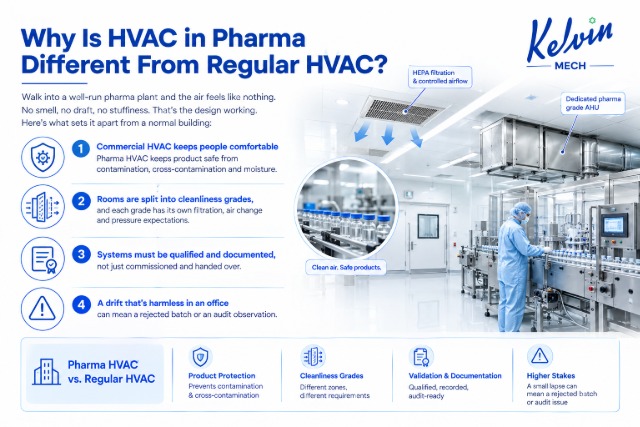
Walk into a well-run pharma plant and the air feels like nothing. No smell, no draft, no stuffiness. That’s the design working. Here’s what sets it apart from a normal building:
- Commercial HVAC keeps people comfortable. Pharma HVAC keeps product safe from contamination, cross-contamination and moisture
- Rooms are split into cleanliness grades, and each grade has its own filtration, air change and pressure expectations
- Systems must be qualified and documented, not just commissioned and handed over
- A drift that’s harmless in an office can mean a rejected batch or an audit observation
We wrote about the same “process first, people second” logic in our guide to semiconductor precision HVAC. Pharma sits in the same family, just with different rulebooks.
What Do Revised Schedule M and WHO GMP Expect From Your HVAC?
Quick background. Revised Schedule M was notified in December 2023. Large manufacturers got six months and MSMEs a year, which was later extended to 31 December 2025. That window has closed, so every unit is now expected to comply.
Schedule M follows WHO GMP thinking, and the HVAC expectations boil down to a few fundamentals:
- Air classified by grade (A to D) based on the activity in each room
- HEPA filtration at the terminal where the grade demands it
- Defined pressure differentials between rooms
- Temperature and humidity held to what the product actually needs
- Separate air handling where cross-contamination risk is high
- Documented qualification (DQ, IQ, OQ, PQ) and periodic requalification
The particle limits behind those grades follow ISO 14644-1, the standard cleanrooms use across industries.
One honest note: the regulations tell you what to achieve. They don’t hand you a design. That gap is where contractor experience matters.
How Should HVAC Zoning Work for API, Formulation and Packaging Areas?
Zoning is where most pharma layout problems begin. One building, three very different air requirements.
API manufacturing
Chemical synthesis, solvents, powders. Containment and safety come first here, not just cleanliness. Solvent areas usually run on 100% fresh air with no recirculation, backed by strong exhaust. Potent compounds need negative-pressure rooms with airlocks so dust stays in. And the final isolation and drying steps, where the API is exposed, need a far cleaner environment than the reaction hall next door.
Formulation and filling
Oral solid areas typically sit at Grade D or C, with dust extraction at source and tight humidity control for moisture-sensitive products. Sterile filling is a different league, with Grade A unidirectional airflow inside a Grade B background. Penicillin, hormones and cytotoxic products need dedicated air handling units with no shared recirculation.
Packaging
Packaging looks like the easy zone. It isn’t. Primary packaging, where product is exposed, needs tighter control than secondary packaging. Mix-up risk, dust, and humidity affecting labels and blisters all matter. It also needs its own pressure relationship with corridors so nothing drifts in.
Why Do Pressure Differentials Matter So Much?
Air always moves from higher pressure to lower. In a pharma plant, that’s your contamination control. Cleaner rooms sit at higher pressure, so air flows outward through any gap. A common design target is 10 to 15 Pascals between adjacent rooms of different classification.
Containment rooms flip the logic. They run at lower pressure so potent dust can’t escape, and airlocks between zones do the heavy lifting.
What goes wrong in practice? Filters load up and airflow changes. Doors get propped open. Dampers drift. That’s why good systems have pressure gauges at every critical door, alarms, and controls that adjust automatically instead of relying on someone to notice.
What Does Temperature and Humidity Validation Involve?
Setpoints are the easy part. Proving you hold them is the work.
Plenty of oral solid plants work to roughly 25°C or below, with relative humidity somewhere between 40 and 60%. But your product’s stability data decides the real number. Moisture-sensitive formulations like effervescent tablets may need humidity under 30%.
Validation usually covers:
- Mapping studies with calibrated sensors across each room, including worst-case spots
- Testing under load, with people, running equipment and doors opening
- Recovery tests showing how fast a room returns to spec after a disturbance
- Alert and action limits, with continuous monitoring through a BMS
- Seasonal proof, because 40°C summers and monsoon humidity stress a system very differently
And qualification isn’t one-and-done. HEPA integrity tests and requalification come around on a schedule, which is why annual HVAC maintenance belongs in your plan from day one.
What Should You Ask Your HVAC Contractor Before Hiring?
Anyone can quote tonnage. Pharma work needs more. Ask these before you shortlist:
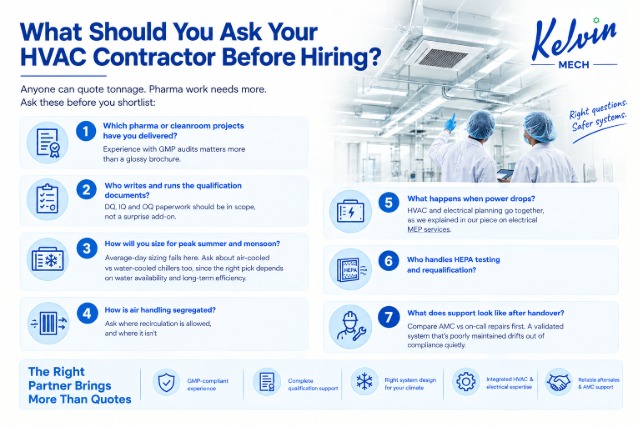
- Which pharma or cleanroom projects have you delivered? Experience with GMP audits matters more than a glossy brochure.
- Who writes and runs the qualification documents? DQ, IQ and OQ paperwork should be in scope, not a surprise add-on.
- How will you size for peak summer and monsoon? Average-day sizing fails here. Ask about air-cooled vs water-cooled chillers too, since the right pick depends on water availability and long-term efficiency.
- How is air handling segregated? Ask where recirculation is allowed, and where it isn’t.
- What happens when power drops? HVAC and electrical planning go together, as we explained in our piece on electrical MEP services.
- Who handles HEPA testing and requalification?
- What does support look like after handover? Compare AMC vs on-call repairs first. A validated system that’s poorly maintained drifts out of compliance quietly.
Where Does Kelvin Mech Fit In?
Kelvin’s HVAC suppliers in India designs around process tolerances first, comfort second. Pharma plants rarely need HVAC alone, so our MEP services cover the electrical side under one coordinated plan. Once the system is validated, our HVAC maintenance contract service helps keep it that way.
Frequently Asked HVAC in Pharma Questions
Is Revised Schedule M mandatory for all pharma plants in India?
Yes. After the MSME extension ended on 31 December 2025, it applies to every pharmaceutical manufacturing unit.
What pressure difference is typical between pharma cleanrooms?
Commonly 10 to 15 Pascals between adjacent rooms of different grades. Exact values depend on design and risk.
What are GMP cleanroom grades?
Grades A to D. Grade A covers the most critical open sterile operations, and Grade D covers the least critical controlled areas.
Do penicillin and hormone products need separate HVAC?
Generally yes. Dedicated air handling units with no shared recirculation prevent cross-contamination.
HVAC in Pharma: Where This Leaves You
Pharma HVAC isn’t a line item to squeeze. It’s a quality system. Get the zoning right, the pressure cascade stable and the validation documented, and audits become routine. Get it wrong and the cost shows up as rejected batches, delayed approvals and expensive retrofits.
India’s pharma sector is growing fast, and Revised Schedule M has raised the bar for everyone in it. Plants that treat HVAC as a GMP asset, not just a utility, pass inspections without the scramble.
Planning a new facility or upgrading an existing one? Talk to Kelvin’s HVAC and MEP team about designing for what your product actually needs.