VRF vs Ductable AC in India: Which Is Right for Your Commercial Building?

Project kickoff meeting. Floor plans on the table. Someone asks the question: VRF or ductable?
Sounds simple, right? Truth is: it isn’t. VRF vs ductable AC India debate shapes your power bill, ceiling height and maintenance calls for the next 15 years. Pick wrong and you’ll feel it every single summer.
Add VRF system vs central AC to the mix and confusion doubles. Everyone has an opinion. Vendors especially.
So here’s a straight comparison. Kelvin Mech – best HVAC suppliers in India – will cover what each system actually is, how they compare on cost, space, efficiency and retrofit, and which building types suit which option. No brochure talk.
Let’s start.
What Do VRF, Ductable and Central AC Actually Mean?
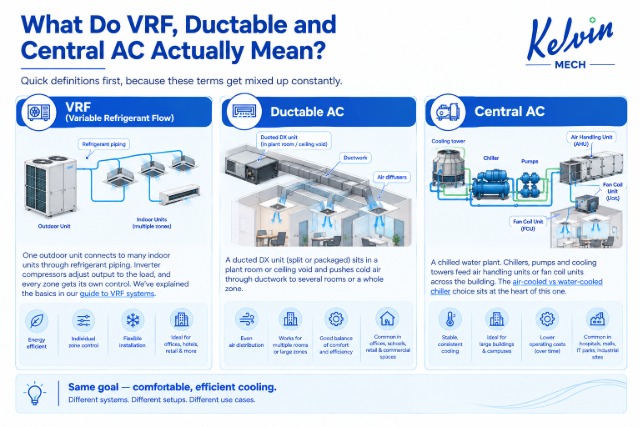
Quick definitions first, because these terms get mixed up constantly.
- VRF (Variable Refrigerant Flow): One outdoor unit connects to many indoor units through refrigerant piping. Inverter compressors adjust output to the load, and every zone gets its own control. We’ve explained the basics in our guide to VRF systems.
- Ductable AC: A ducted DX unit (split or packaged) sits in a plant room or ceiling void and pushes cold air through ductwork to several rooms or a whole zone.
- Central AC: A chilled water plant. Chillers, pumps and cooling towers feed air handling units or fan coil units across the building. The air-cooled vs water-cooled chiller choice sits at the heart of this one.
VRF vs Ductable AC vs Central AC: Head-to-Head
| Factor | VRF | Ductable AC | Central AC |
| Upfront cost | Medium to high | Lowest | Highest at small scale, competitive at large scale |
| Scalability | Easy to add indoor units, within system limits | Limited by duct and unit capacity | Best for very large loads |
| Energy efficiency | High at part load | Moderate | High, especially water-cooled at scale |
| Space needed | Small indoor units, no big plant room | Ducts eat ceiling height | Plant room, chillers, risers |
| Zone control | Excellent, room by room | Limited, per duct zone | Good with proper controls |
| Retrofit ease | Good | Good if ducts exist | Hardest |
The table gives you the gist. Now the reasoning behind it.
Cost and scalability
Ductable wins the sticker price almost every time. It’s simple kit with simple installation. VRF costs more upfront because of inverter technology, branch boxes and copper piping. Central AC costs the most to set up, though the cost per tonne drops as the building grows.
Scalability is where VRF shines for mid-size buildings. Planning to fit out the next floor in two years? Add indoor units. With ductable, extra capacity often means another unit and more ducting.
Energy efficiency
VRF’s inverter compressors slow down when the load drops, which is most of the day in most offices. A study from Oak Ridge National Laboratory found VRF systems saving roughly 15 to 42% in HVAC site energy compared with rooftop VAV systems in US simulations. Indian conditions differ, and real results depend on design and use, so treat it as direction, not a promise.
Efficiency also matters for compliance. India’s Energy Conservation Building Code covers new commercial buildings above 100 kW connected load, and HVAC equipment efficiency is part of it. Ask any vendor for rated performance at your site’s peak summer temperature, not at ideal test conditions.
Floor space and ceiling height
Ducts need room. Big supply ducts can swallow 300 to 500 mm of ceiling void, which hurts in buildings with tight floor-to-floor heights. VRF only needs refrigerant pipes and compact indoor units. That’s why developers often favour it for space-constrained projects.
Retrofit ease
Replacing old ductable units with VRF is common, especially in older offices. Central AC retrofits are tougher because of chiller rooms and risers. Heritage structures bring their own constraints, as we covered in our piece on HVAC retrofits for heritage buildings.
What About Total Cost of Ownership?
Here’s the part quotes don’t show. A system that’s cheapest on day one can cost more by year ten.
Look at the full picture over 10 to 15 years:
- Energy: Often the biggest line. Part-load efficiency matters more than peak efficiency
- Maintenance: VRF needs trained technicians and clean refrigerant circuits. Central AC needs plant operators. Ductable needs duct and filter cleaning
- Repairs: A compressor failure on a VRF can affect many indoor units at once
- Lifespan: Central plant equipment usually outlasts packaged and VRF equipment
- Downtime risk: One outdoor unit serving a whole floor means one fault can hit everyone
We broke down service costs in how much an HVAC AMC really costs in India. The short version: a good HVAC annual maintenance plan protects your efficiency numbers more than any spec sheet.
Which System Suits Which Building?
There’s no universal winner. Here’s how it usually plays out:
- Small offices, clinics, showrooms: Ductable is often enough. Lower cost, simple operation
- Mid-size offices, co-working spaces, hotels, mixed-use floors: VRF fits well, especially with varied occupancy and individual zone control
- Large malls, IT parks, campuses, hospitals: Central AC usually makes more sense at that scale, with better efficiency and longer lifespan
- Buildings with tight ceilings or phased fit-outs: VRF, for the space and expansion flexibility
Hospitals and labs also need tight humidity and fresh air control, which usually pushes them towards central systems.
Mistakes to Avoid When Choosing
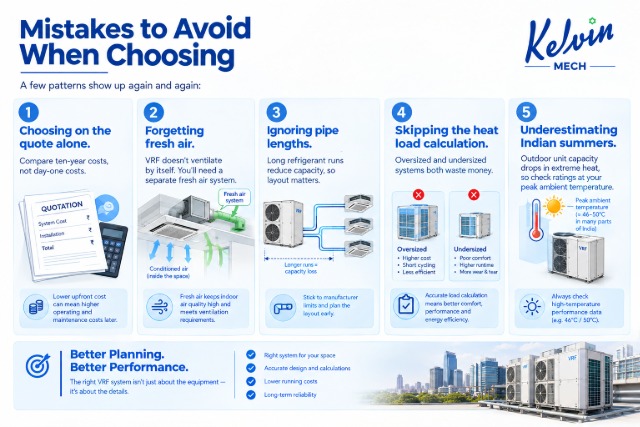
A few patterns show up again and again:
- Choosing on the quote alone. Compare ten-year costs, not day-one costs
- Forgetting fresh air. VRF doesn’t ventilate by itself. You’ll need a separate fresh air system
- Ignoring pipe lengths. Long refrigerant runs reduce capacity, so layout matters
- Skipping the heat load calculation. Oversized and undersized systems both waste money
- Underestimating Indian summers. Outdoor unit capacity drops in extreme heat, so check ratings at your peak ambient temperature
Where Does Kelvin Mech Fit In?
We’re vendor-neutral on purpose. The right answer depends on your building, not our inventory. Kelvin’s HVAC company in Mumbai starts with load calculations and building use, then recommends the system. Our MEP services coordinate the electrical and plumbing side, and our HVAC maintenance service keeps the system performing after handover.
Frequently Asked VRF vs Ductable AC Questions
Is VRF better than ductable AC in India?
Not always. VRF suits buildings that need zone control and flexible expansion. Ductable works well for smaller, simpler spaces with a tighter budget.
Is VRF cheaper than central AC?
For small and mid-size buildings, often yes. For very large buildings, central AC usually becomes more cost-effective per tonne.
Can I replace ductable AC with VRF?
Yes, and it’s a common upgrade. Existing ducts may be reused or removed depending on layout, so a site survey comes first.
Does VRF need a separate fresh air system?
Yes. VRF handles cooling, not ventilation, so plan a dedicated fresh air unit.
Which system has the lowest running cost?
Usually VRF or a well-designed central plant, thanks to part-load efficiency. Ductable tends to cost more to run over time.
VRF vs Ductable AC India: Where This Leaves You
Both systems work. The question is which one fits your building, your growth plans and your budget over the next decade. Ductable gives you simplicity. VRF gives you flexibility and part-load savings. Central AC gives you scale and longevity.
Start with the load, the layout and the ten-year numbers. Then choose. That order saves money. Choosing first and justifying later rarely does.
Comparing options for a new building or a refit? Talk to Kelvin’s HVAC team and get a recommendation based on your actual floor plan, not a catalogue.